
Tag Archives: westminster system

Custom and Precedence

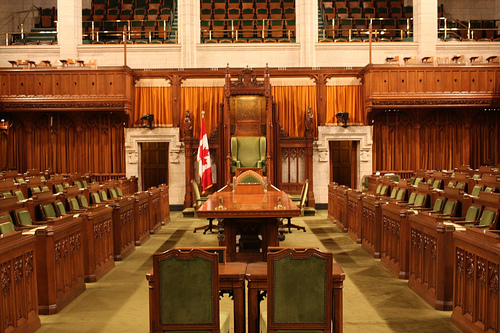
commonsfloor At the start of each Parliament the Speaker after the members of the House of Commons are sworn in asks “who should the Governor-General call upon to form a government”? The four most endorsed candidates are invited to Rideau Hall and asked to form a council-designate, a government-in-waiting. After each leader who accepts forms a proposed government of say 16 to 20 members the Speaker puts the question to the House “which of these councils-designate has the confidence of this House”? The two with the least are dropped from the second ballot. The Commons votes a second time with the winner becoming the Council of Ministers and the loser the Council of Opposition. No vote in the House triggers an election only an absolute 2/3 majority (226 out of 338) passing a motion of dissolution can trigger an election before the set election day. No vote can replace the current government with another. The Council of Ministers is the government for the duration of that Parliament. Any individual minister can be dismissed by a 60% vote of the House. If it’s the Prime Minister then an absolute 60% majority (203).
Government formation part 2

westminster

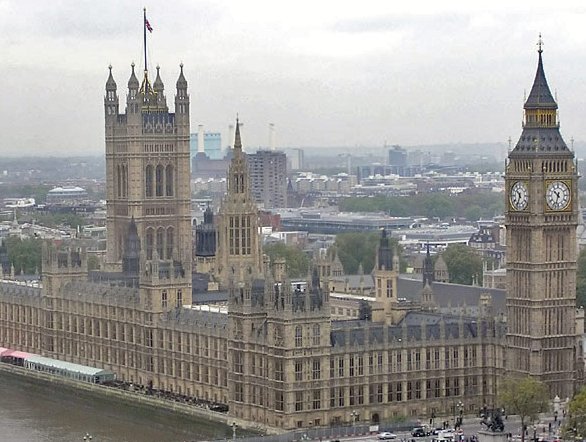
An alternative to the current process used in the United Kingdom and others with the Westminster system. This is using the UK as an example.

  • General election Thursday May 7, 2015
  • Parliament reconvenes on the second Monday after an election. This is 11 days after the election and for this election that is Monday May 18.
  • Monday morning swear in the new members of parliament.
  • Monday afternoon elect the Speaker.
  • Tuesday the Speaker ask the House of Commons to nominate individuals to be called upon to form a government. A nominee must have at least 5% of the membership of the House or 33 members endorsing them.
  • If there is more then four nominees then the four with the most endorsements are called upon to form a council-designate which is a government in waiting. If there are four or less all are called to form a council-designate.
  • Obviously before the UK Parliament meets there will be intensive negotiations behind the scenes to form a majority coalition if no party has the majority.
  • This is done Tuesday morning and later the Speaker of the Commons calls upon Her Majesty to invite the listed individuals to form council-designates.
  • Tuesday afternoon they are called in at 1, 2, 3, and 4 o’clock and are invited by the sovereign to form a governments-in-waiting to be called upon by Her Majesty to form the government should they have the confidence of the House of Commons.
  • Each nominee then forms a council-designate of say 16-24 members that would form the government should it have the confidence of the House.
  • Wednesday morning the Commons then votes on the question, “which of these councils-designate has the confidence of this House to form Her Majesty’s government in this Parliament ?
  • If no council gets a majority then a second vote is held with only the top two from the first vote on it. The council with the majority becomes the Council of Ministers and the runner up council becomes the Council of Opposition.
  • In 2005 the first vote would be something like Labour 411, Conservative 174, and Liberal Democrat 55. Labour forms the government, conservatives the opposition, and the Liberal Democrats an alternate council. After the last election the first and only vote would be something like Coalition (Tory/Lib-Dem) 415 and Labour 217. A coalition government and Labour as the opposition.
  • Parliament would have a fixed term and set election day. You can only have early elections by a motion of dissolution passing the Commons by 480 votes (75%).
  • There are no non-confidence motions. The government serves for the duration of that Parliament unless the Commons passes a motion of dismissal against the government and replaces it with another.
  • Any minister can be removed by a motion of dismissal passed by a 2/3 majority vote with quorum, including the PM.
  • The Council of Ministers can be replaced by a motion of government dismissal passed by an absolute 2/3 majority. This motion must have a nominee for Prime Minister who is called upon to form a new government if the motion of dismissal against the government gets the 434 votes. No member of the defeated government can be included in this new government.

Greater stability since the House of Commons establishes confidence in a government right at the start of a new Parliament and the government serves for the duration of that Parliament which has a fixed term and set election day. Only by super majorities can this be changed. An absolute 2/3 majority to replace the current government with a new one that then serves till the next election or an absolute 3/4 majority vote that actually does dissolve Parliament and triggers new elections. Note the scheduled general election still occurs so instead of having 1 full Parliament that lasts 4 years you have two short Parliaments that last a combined duration of 4 years. The second short Parliament can not be dissolved for early elections.

Acting president: Barry Aulis

Quebec Election

The big day is here. It’s Quebec’s general election for 2012. Me and my neighbor got to our polling station about five minutes before it opened. Already about a dozen people were there and more were coming as we went in. So hopefully we will have a good voter turnout for this election. Here is an alternate process for the determination of the formation of a government.

Custom and precedence

After each General election you would have the following sequence of events. The fourth Monday after each election you would have the swearing in of the elected members of the National Assembly. That Tuesday the Assembly would elect it’s Speaker. On Wednesday the Speaker would ask the Assembly on whom the lieutenant governor should ask to form the Government. On Thursday the top four candidates are asked to form a government by the lieutenant governor subject to the approval of the National Assembly. On Friday morning the Speaker puts to the National Assembly the question which of these Councils has the confidence of the Assembly to form the government of the province of Québec? The National Assembly then votes. The Speaker then swears in the third and fourth place councils as alternate Councils in the Assembly. Friday afternoon the National Assembly votes a second time on the two remaining councils. The winner becomes the government and the loser becomes the official opposition. The following Sunday the losing Council is sworn in as the Council of Opposition and the winning Council as the Council of Ministers for the government of Québec.

This process starts 28 days after each election and ends 34 days after the election with the swearing in of the Opposition and Quebec’s Government. For this General election the process would begin on Monday, October 1 with the swearing in on Sunday, October 7. Of course the negotiations leading up to Swearing In week would already settle the make-up of the Council-designates and almost certainly the outcome of the vote of confidence in the National Assembly.