Committee


Long ago I delt with this issue and came up with 18 Common’s committees each having 20 seats for 360 committee assignments in total. They are awarded in proportion to each Party’s seats in the House of Commons with Independents treated as a bloc like a Party.
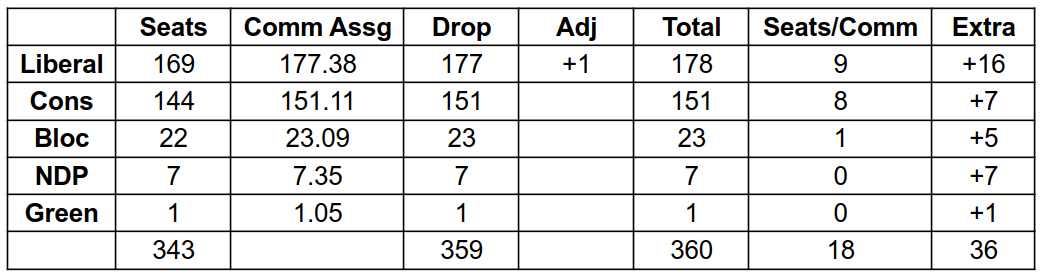
Seats is the number of seats held in the House of Commons.

Comm assg is the number of committee assignments out of (Seats/343) X 360.

Drop is drop the decimal remainder.

Adj is awarding one extra assignment in order of highest decimal remainder till you get the 360 total committee seats.

Total is the total number of committee seats a Party is assigned.

Seats/Comm is the number of seats they have on every committee.

Extra is the seats left over which is 36 assignments or 2 seats per committee.

The extra seats are chosen by the House Leaders in order of largest to smallest so, Liberal, Conservative, Bloc, NDP, and then Mrs. Elizabeth May.

The first round each House Leader chooses 1 committee seat for their Party then Mrs. May chooses hers. This process goes round after round until all 360 committee seats have been assigned.

Independents are treated as a Party for the determination of the number of committee assignments but are chosen by the Independent MPs in order of seniority. Each round when the Independents choose, the most senior MP who hasn’t chosen a committee assignment selects one that’s open.

All MPs get to sit on at least 1 committee with some getting 2 assignments.

One Vote Part 3

“One vote more then everyone else and you’re everything. One vote less then anyone else and you are nothing.” Barry Aulis

This is the logic of the First Past The Post electoral system. See the post One Vote below.

Windsor Tecumseh Lakeshore – Ontario

With the Dual Electoral System 3 candidates would have been elected in this Riding, the Conservative, Liberal, and NDP candidates. Depending on how the other 4 candidates transfer their votes the Riding’s 3 MPs would have the following votes when the House of Commons is in legislative session.

Kathy Borrelli: 32,090 to 33,812

Irek Kusmierczyk: 32,086 to 33,808

Alex Ilijoski: 4,240 to 5,962

The other 4 candidates would transfer their votes to one of the above or do no transfer and those votes disappear and don’t count towards the passing of legislation in the House of Commons.

Again “try it before you buy it” form the House Advisory Council composed of the top 2 candidates in each Riding with the 3rd and 4th if they got 5% of the vote. The remaining candidates transfer their votes to one of the candidates from their Riding who did get elected. They also have the option of no transfer in which case those votes disappear and don’t count towards deciding what bills get passed in legislative session.

If the Dual Electoral System was adopted reduce the number of Ridings to 300 giving you 600 to 1200 MPs of which only 300 sit in the House these are the Sitting Members of the House the rest are Non Sitting Members of the House. You could half the number of Ridings to 150 giving you 300 to 600 MPs of which again 300 would be Sitting Members and the rest being Non Sitting Members.

The Original version of the Dual Electoral System had the top 2 in each Riding being elected and the rest transferring their votes to one of these elected candidates. Hence if you keep the same number of Ridings you will double the number of members. Keep the same number of MPs and you half the number of Ridings thus doubling the number of voters each has and increasing their area covered.

One Vote Part 2

“One vote more then everyone else and you’re everything. One vote less then anyone else and you are nothing.” Barry Aulis

This is the logic of the First Past The Post electoral system. See the post One Vote below.

Terra Nova – Newfoundland & Labrador

With the Dual Electoral System 2 candidates would have been elected in Terra Nova the Liberal and Conservative candidates. Depending on how Liam Ryan transfers his votes the Riding’s 2 MPs would have the following votes when the House of Commons is in legislative session.

Anthony Germain: 19,704 or 21,381

Jonathan Rowe: 19,692 or 21,369

Liam Ryan would transfer his 1677 votes to either Germain or Rowe or do no transfer and those votes disappear and don’t count towards the passing of legislation in the House of Commons.

Again “try it before you buy it” form the House Advisory Council composed of the top 2 candidates in each Riding with the 3rd and 4th if they got 5% of the vote. The remaining candidates transfer their votes to one of the candidates from their Riding who did get elected. They also have the option of no transfer in which case those votes disappear and don’t count towards deciding what bills get passed in legislative session.

If the Dual Electoral System was adopted reduce the number of Ridings to 300 giving you 600 to 1200 MPs of which only 300 sit in the House these are the Sitting Members of the House the rest are Non Sitting Members of the House. You could half the number of Ridings to 150 giving you 300 to 600 MPs of which again 300 would be Sitting Members and the rest being Non Sitting Members.

The Original version of the Dual Electoral System had the top 2 in each Riding being elected and the rest transferring their votes to one of these elected candidates. Hence if you keep the same number of Ridings you will double the number of members. Keep the same number of MPs and you half the number of Ridings thus doubling the number of voters each has and increasing their area covered.

Percentage


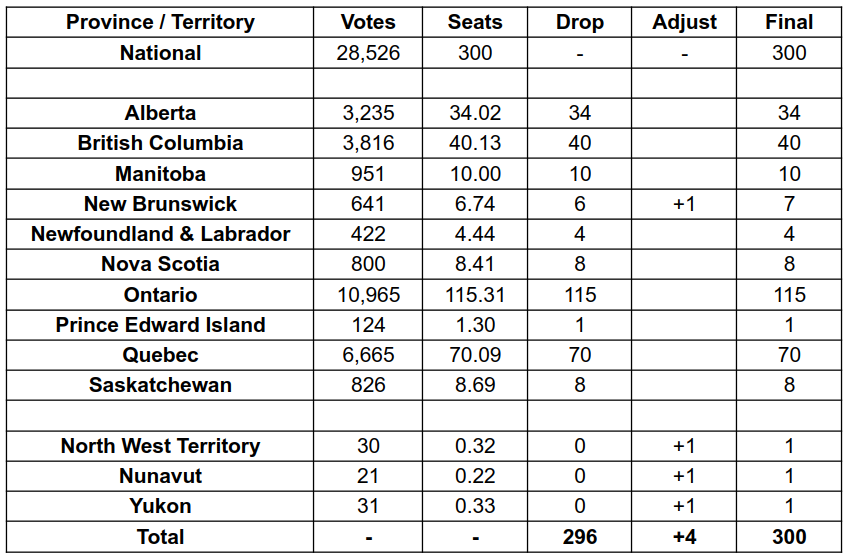
If you have X% of the eligible voters you will have X% of the seats. Modified to guaranty that every region has one seat.

Votes are the number of eligible voters in the last election expressed in the thousands.

Seats are the number of seats to 2 decimal places.

Drop is dropping the decimal remainder leaving you with 296 seats.

Adjust is the adjustment of adding 4 seats to bring the total to 300. The 3 Territories each get 1 since every province or territory is guarantied at least 1 seat. The remaining 1 seat adjustment goes to New Brunswick since it is the one with the highest decimal remainder.

Final is the seat count after the adjustment.

One Vote

“One vote more then everyone else and you’re everything. One vote less then anyone else and you are nothing.” Barry Aulis

This is the logic of the First Past The Post electoral system and the recount in Terrebonne literally just proved that statement!

With the Dual Electoral System 3 candidates would have been elected in Terrebonne; the Liberal, Bloc, and Conservative candidates. Depending on how the 3 remaining candidates transfer their votes, the Riding’s 3 MPs would have the following votes when the House of Commons is in legislative session.

Tatiana Auguste: 23,352 to 25,966

Nathalie Sinclair-Desgagné: 23,351 to 25,965

Adrienne Charles: 10,961 to 13,575

My own Riding of Compton-Stanstead would have the same result; the Liberal, Bloc, and Conservative candidates being elected with the NDP, Green, and People’s Party candidates transferring their votes to one of the 3 elected candidates.

Again “try it before you buy it” form the House Advisory Council composed of the top 2 candidates in each Riding with the 3rd and 4th if they got 5% of the vote. The remaining candidates transfer their votes to one of the candidates from their Riding who did get elected. They also have the option of no transfer in which case those votes disappear and don’t count towards deciding what bills get passed in legislative session.

If the Dual Electoral System was adopted reduce the number of Ridings to 300 giving you 600 to 1200 MPs of which only 300 sit in the House these are the Sitting Members of the House the rest are Non Sitting Members of the House. You could half the number of Ridings to 150 giving you 300 to 600 MPs of which again 300 would be Sitting Members and the rest being Non Sitting Members.

The Original version of the Dual Electoral System had the top 2 in each Riding being elected and the rest transferring their votes to one of these elected candidates. Hence if you keep the same number of Ridings you will double the number of members. Keep the same number of MPs and you half the number of Ridings thus doubling the number of voters each has and increasing their area covered.