
 The Dual Electoral System is inspired from the House of Commons where you have a Leader representing the majority of the House and a Leader representing the largest minority of the House. Voting is conducted by a secret preference ballot where the voters mark the candidates in order of choice (1, 2, 3, 4, etc). The ballots are counted with the two candidates with the most votes getting elected. The ballots are counted a second time where the elected candidate with the lower number gets one Legislative vote for every vote received on the second count. In regular session each member has one vote which for the last New Brunswick General election would give both the PC and Liberals one vote less then 50%. The Legislature would operate on a consensual basis because no party can get a majority in regular session. The legislature would have a legislative session once a week where any bills requiring approval are voted on. Each member would have votes equal to their popular vote in their riding. All votes do count in an election for one of the elected candidates from your riding will receive your vote and cast it in Legislative session to determine the passage of legislation.
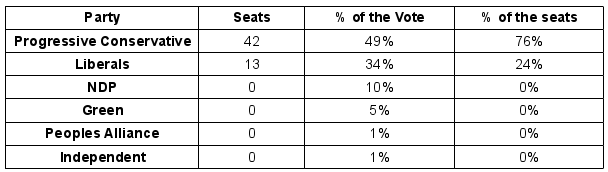
As the first table shows in the last General Election in New Brunswick ended with the PCs getting 76% of the seats though a majority of the voters voted against the conservatives. Also 17% of the voters voted for parties that gained no seat and so all those voters have no representation of any kind in the Legislature. The phrase “Taxation without Representation” comes to mind.
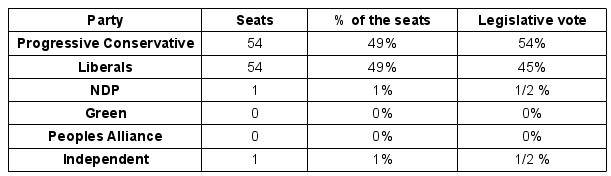
The second table shows the results using the Dual Electoral System. The top two candidates in each riding are elected. This gives both the Conservatives and Liberals the same number of seats and one seat shy of 50%. In regular session its one member one vote so no party rules the Legislature. In the riding of Woodstock the top two candidates were the PC candidate and an Independent Mr David Allen. In the riding of Tracadia-Shelia the top two candidates were the candidates for the Liberals and the NDP. In all other riding’s the top two candidates belonged to the PC and Liberals.
In Legislative session for the riding’s that elected the PC and Liberal candidates I made the assumption that 2/3 of the remaining vote would go Liberal and 1/3 to the PC. For the riding of Woodstock I decided all the secondary vote goes to the Independent candidate Mr David Allen. For the riding of Tracadia-Shelia I awarded all the votes for the PC to the Liberals and none to the NDP. The Legislative vote that the PC and Liberal parties would have better reflects the way the voters voted; PC 54% Leg / 49% Pop, Liberal 45% Leg / 34% Pop. Also all the votes cast for the other candidates just doesn’t disappear they go somewhere. If your vote doesn’t go to your first choice it goes to a secondary choice who in effect proxy votes it in the Legislative session of the New Brunswick Legislature. All votes do count!
If the Dual Electoral System were ever used create 25 provincial ridings with the smallest having at least 50% of the number of electors as the largest riding. This gives you a Legislature of 50 members from 25 dual member ridings. Each member having a number of votes in Legislative session equal to the votes received on the second count of the ballots. You mark your preference for all candidates and one of them will be voting your vote in the New Brunswick Legislature.
The New Brunswick Legislature should first create the Legislative Council consisting of the top two candidates in every riding giving you 98 members. In regular session of the Council its one member one vote. In each riding all the other candidates transfer their popular vote to one of the elected candidates for that riding. This is added to their own popular vote and the total is the number of votes they have when the Council is in Legislative session. The Legislative Council advises the Legislature by regular session on all motions before it. When the Legislature votes to pass a bill the Council advises it by voting in Legislative session. The 49 runner up candidates for each riding don’t get paid. With the operation of this advisory council one would get to see how the Legislature would work under the Dual Electoral System . In other words you can “try it before you buy it”!
 The Federalist party of Canada