The letter I’ve sent to all the Liberal senators over the last 2 months usually 1 a day.
I just noticed that His Excellency, Governor General David Johnson was appointed in October of 2010. Here is a different method for the appointment of the Governor General of Canada that removes the Political Monarch (PM) from the process and makes the office independent of the PM of the day. I believe the slogan is “Real Change”. This process can also be applied to the Senate of Canada.
“There shall be a Council to aid and advise in the Government of Canada, to be styled the Queen’s Privy Council for Canada; and the Persons who are to be Members of that Council shall be from Time to Time chosen and summoned by the Governor General and sworn in as Privy Councillors, and Members thereof may be from Time to Time removed by the Governor General.”
Constitutional Act, 1867 Section 3 Article 11
The Privy Council would have members who are appointed or ex-officio. The ex-officio members are appointed to the Privy Council when they are appointed to the office that gives membership in the Privy Council. They are removed from the Privy Council when they no longer hold that office. These would be the members of the Council of Ministers and the Council of Opposition. An act of Parliament, not order-in-council, would set the ministers of the crown. The ministers or opposition councillors that hold these portfolios are always in the cabinet or opposition council and can never hold more then one at a time. Ministers of state can be in cabinet or their opposites in the Council of Opposition, but this is not automatic. Thus in the government of Canada the senior portfolios are held by the ministers of the crown and the junior by the ministers of state.
There will be a maximum of 216 appointed members who serve for life. By custom and precedence those who are the following are appointed Privy Councillors for Canada, Speaker of the House, Speaker of the Senate, Justices of the Supreme court, Prime minister and Leader of the opposition, Governor General, and Lieutenant Governors of the provinces. When there is a vacancy the following can nominate a person for appointment. The Governor General can nominate people for appointment. The Lieutenant Governors can nominate some one from their province. Three Privy councillors can nominate a person. The top two candidates from a riding can nominate some one from their province or territory. The nominees are put to a confirming vote of the House Advisory Council. This body consists of the top two candidates in each riding, which gives a council of 676 members, 301 Liberals (45%), 223 Conservatives (33%), 128 NDP (19%), 21 Bloc (3%), 2 Green, and 1 Independent. To be confirmed takes a 2/3 majority by a secret ballot. Every nominee gets voted on yes or no. If more then one gets confirmed then it’s the one with the most votes that gets appointed.
Distribution of the Privy Councillors is shown in the table. Each province gets 9 councillors with the 3 northern territories getting the same for 3 councillors each. The natives not in the territories counts as a province so get 9 as well. This gives a total of 108. A further 108 seats is distributed among the above on the basis of eligible voters in the last General election. Half the Privy Council is by population and the other half by equal representation.
|
Province / Territory
|
% of voters
|
Population
|
Equal
|
# of Councillors
|
|
British Columbia
|
12.38%
|
13
|
9
|
22
|
|
Alberta
|
10.35%
|
11
|
9
|
20
|
|
Saskatchewan
|
2.83%
|
3
|
9
|
12
|
|
Manitoba
|
3.23%
|
4
|
9
|
13
|
|
Ontario
|
35.42%
|
38
|
9
|
47
|
|
Quebec
|
23.62%
|
26
|
9
|
35
|
|
New Brunswick
|
2.20%
|
2
|
9
|
11
|
|
Nova Scotia
|
2.72%
|
3
|
9
|
12
|
|
PEI
|
0.42%
|
1
|
9
|
10
|
|
Newfoundland
|
1.55%
|
2
|
9
|
11
|
|
Yukon
|
0.10%
|
0
|
3
|
3
|
|
NWT
|
0.11%
|
0
|
3
|
3
|
|
Nunavut
|
0.07%
|
0
|
3
|
3
|
|
Natives
|
~5.00%
|
5
|
9
|
14
|
|
Total
|
|
108
|
108
|
216
|
It is the appointed members who advise the Queen on the selection of a person for the position of Governor General of Canada. The Privy Council is assembled with Queen in Council and it takes 3 privy councillors to nominate some one as Governor General. All nominated individuals who are councillors are asked to leave and the council debates on which one to appoint. After the debate any nominated members are asked back in and the Privy Council votes yes or no for each one by secret ballot. On the first ballot it takes 75% to get recommended for appointment. If there is more then one then Her Majesty can appoint any one of the nominees. If no one gets the required 75% then there is a second ballot where it takes a 2/3 majority to get recommended for appointment. A third ballot requires only a 60% vote. A fourth and final ballot requires a simple majority. If still no nominee with a recommend ballot then the process is started over with no past nominee on the ballot. Once the Queen appoints a person as Governor General it must be confirmed by the House Advisory Council. Confirmation takes an absolute 2/3 majority (451) by secret ballot.
The Governor General serves for a 12-year term. By a 2/3 majority vote the Privy Council can recommend extending the term of office by 6 years. By a 75% vote can recommend a second and last extension, also of 6 years. The House Advisory Council must confirm these extensions by secret ballot by an absolute 75% vote (507). The Privy Council can recommend the removal of the Governor General by an absolute 2/3 majority vote of the current members.
Reform of Senate membership (same process as the Privy council)
|
Province / Territory
|
% of voters
|
Population
|
Equal
|
# of Senators
|
|
British Columbia
|
13.03%
|
4
|
3
|
7 (6)*
|
|
Alberta
|
10.89%
|
4
|
3
|
7 (6)*
|
|
Saskatchewan
|
2.98%
|
1
|
3
|
4
|
|
Manitoba
|
3.41%
|
1
|
3
|
4
|
|
Ontario
|
37.29%
|
12
|
3
|
15
|
|
Quebec
|
24.86%
|
8
|
3
|
11
|
|
New Brunswick
|
2.31%
|
1
|
3
|
4
|
|
Nova Scotia
|
2.87%
|
1
|
3
|
4
|
|
PEI
|
0.44%
|
0
|
3
|
3
|
|
Newfoundland
|
1.62%
|
1
|
3
|
4
|
|
Yukon
|
0.10%
|
0
|
1
|
1
|
|
NWT
|
0.11%
|
0
|
1
|
1
|
|
Nunavut
|
0.07%
|
0
|
1
|
1
|
|
Total
|
|
33
|
33
|
66 (64)*
|
*BC & Alberta limited to a maximum of 6 seats
A reform of the Senate membership changed to 66 senators. When a seat goes vacant the top two candidates in a riding in that province or territory nominate someone for appointment. All the nominees go to a yes or no secret ballot vote of the House Advisory Council. It takes an absolute 2/3 majority (451) to get confirmed. If more then one gets the required vote then the one with the most is appointed. Membership is for 25 years after which a senator becomes a senator emeritus. These senators can attend and speak in chamber but can’t sit on any subsidiary body and have no vote. When a senator retires to this position their seat as a voting senator is vacated. To start the membership all current senators stay as long as it doesn’t exceed the number of senators for that province or territory. Any in excess then the most junior senators voluntary resign their seats. Also any who have been there 25 years become a senator emeritus. The voting senators become emeritus when they hit the 25-year mark.
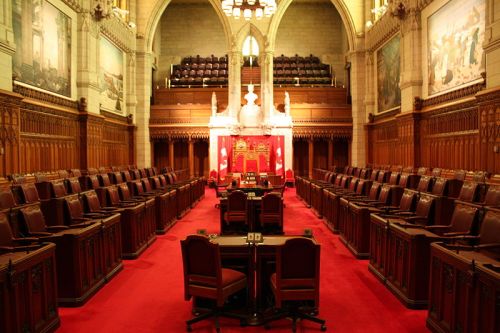
The Senate of Canada is solely a chamber of sober second thought. It is non-partisan and appointment is through a process independent from the Political Monarch of the day. All appointees can’t be members of political parties or association. They cannot donate to such organizations or attend any of their meetings. The House of Commons establishes a legislative session where any bills to be passed is voted on each week. This is to be Wednesday at 1 PM. The Senate’s legislative session would be Thursday at 1 PM where any bill that passed the House on Wednesday is voted on. If passed it goes to the Governor General on Friday for royal assent.
The Senate by a majority vote may send a bill back to the House with or without recommendations. The next week in the Commons the bill can be withdrawn, voted on, or tabled for revision. If the sponsor withdraws the bill, it kills it. The sponsor can have the bill voted on “as is” for a second time on Wednesday’s legislative session. The bill can be tabled for revision in which case the sponsor has 90 days to introduce a revised bill or the bill is deemed withdrawn from consideration by the House. The second time the Senate gets a bill by a 2/3 majority can send it back to the House with objections. If the bill passes the Commons for the third time the Senate passes the bill and sends it to the Governor General. Thus the Senate at most can delay any bill by 2 weeks.
As long as the Senate is partisan-appointed and partisan in operation it cannot be a sober chamber of second thought. As long as it is not elected it has no right to block legislation passed by the House of Commons. A New Year and maybe Senate reform for 2016.
 Sincerely yours,

 As I have posted before, a different way then how senate confirmation of presidential appointments are currently done. This idea occurred to me after the nomination of Judge Bork by President Reagan. The Senate has every right to confirm, every right to reject, but no right to not vote in a timely matter. What the Democrats did then and what the Republicans in an even worse way intend to do now is wrong! For good reasons, bad reasons, or no reason the Senate is to confirm or reject every appointment made by any President of the United States.
 “Real Change” does it again.
 The Federalist party of Canada