Tag Archives: federalist party

Dual Electoral System

42nd Federal election results

Party

Liberal

Cons

NDP

Bloc

Green

Ind

Seats

184

99

44

10

1

0

Dual

301

223

128

21

2

1

House votes

54%

29%

13%

3%

0.3%

0%

Dual votes

51%

29%

18%

3%

0.5%

0.1%

With Liberal/Cons members elected the NDP & Bloc & Green go to the Liberals

Liberal/NDP members elected the Bloc & Green to NDP , Cons 2/3 to Liberals

Cons/NDP members elected the Liberal & Bloc & Green to the NDP

Liberal/Bloc members elected the NDP & Green & Cons 1/2 to each

NDP/Bloc members elected the Liberal & Green to NDP , Cons 1/2 to each

Dual Electoral System

A preference ballot is used for voting. The candidate with the number one on a ballot gets one vote. The two candidates with the most votes are elected. The ballots are counted a second time with the elected candidate with the lower number getting one vote. Each elected member will have one ” member vote ” in the House to be used in regular sessions and one ” legislative vote ” for each vote received on the second count of the ballots. These votes are voted when the House is in legislative session and is used to pass, what else, legislation! One day a week is set by the Commons for the legislative session and any bills requiring third reading are voted on during that session.

The main drawback of this system is if you keep the same number of ridings you will double the number of members or having the same number of members will double the size of the electoral ridings.

Benefits of the Dual Electoral System

  1. Guarantee of an opposition since no party can have more than 50% of the members.
  2. In regular sessions the members have one vote each so there will be non-partisan voting on the election of the Speaker, rules of the House (2/3 majority), procedural motions and committee membership.
  3. In legislative session you will have proportional representation since each member will have one vote for each vote received on the second count of the ballots.
  4. No party lists since your still voting for the Member of Parliament of your choice. One MP represents the majority vote in a riding and the other MP the main minority vote.
  5. No major revision of the electoral map. Ridings should only be altered when the number of electors in a riding is 50% or less of the number of electors in the largest riding. Each election few if any ridings will change. This will mitigate the political fighting over riding boundaries or size for the purpose of any real or imagined partisan gain.
  6. An incentive to vote since the more votes an MP gets the more votes they have on voting on legislation. Also ridings will increase their voting strength in the House if their voting turn out is higher than the average.
  7. All votes do count! If your first choice doesn’t get elected then one of the two candidates who did get elected will get to vote your vote because of the preference ballot.

If the dual electoral system were to be used it would have to be decided what the maximum size of the House of Commons should be. A House of Commons of 300 members would give you 150 ridings electing 2 members each. This results in an 11% reduction in the size of the Commons and a 125% increase in the size of the ridings. The Party standings in such a House would roughly be 134 Liberals, 99 Conservatives, 57 NDP, 9 Bloc, and 1 Green.

You can try it before you buy it by forming the House advisory council. This council to consist of the top two candidates for each riding. This giving a council of 676 members all having one vote in regular session. All the other candidates in each riding transfers their popular votes to one of the council members from their riding. This added to their own gives the number of votes they have in the council in legislative session. The Council in regular session advises the Commons on procedural votes and in legislative session advises the House on the passage of legislation.
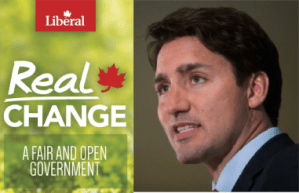
 

Mr. Real Change

g3403

http://www.cbc.ca/news/politics/government-ads-liberals-1.3455529

As always with the change of government the new one promptly starts behaving like the previous government they criticized while in opposition. As with all these Political Monarchs (PM / Premier) “Some are better, some are worse, but in the end, they are all the same.”

There is to be created the Council of State which consists of the Council of Ministers and the Council of Opposition. This would include only those who hold the senior portfolios of the ministers of the crown as defined in an Act of Parliament and not the whim of the PM (Political Monarch) of the day. Equal number of members from both the government and the opposition of the day and presided over by the Governor-General. It would be this body that sets the rules governing the communications policy of the government of Canada and it’s departments and agencies. This requires a 2/3 majority vote of the council if introduced by the Prime Minister and the Leader of the Opposition. If introduced be just one of them then it requires a three-quarter majority vote.

Also as a direct subsidiary body you would have the Federal Government Communication Office (FGCO) charged with overseeing the implementation of federal communication policy. Chairman would be the Minister of state responsible for the FGCO and deputy chairman the opposite number in the Opposition. Also included are the minister of public service, the minister of heritage, and their opposite numbers in the Council of Opposition. At the start of each Parliament the Council of Ministers and the Council of Opposition each appoints a member of the FGCO who would serve for the duration of 3 Parliaments. Half the membership comes from the government and half from the opposition. Half are from the cabinet and the opposition council and half are appointed members with long terms of office.

The FGCO would currently have 6 Conservatives, 5 Liberals, and 1 NDP. This would include 3 Liberal ministers, 3 Conservatives in the opposition council, 3 conservative members, 2 liberal members, and 1 NDP member. The approval of the FGCO would be required for any advertising by the government of Canada and this needs the vote of 8 of the 12. Control of the Government of Canada’s website would be under the jurisdiction of the FGCO. Non partisan and not run out of the PMO and doesn’t stand a chance of happening. Some variation of the same old is all we can expect.

The Three Choices

g3827

The three choices:

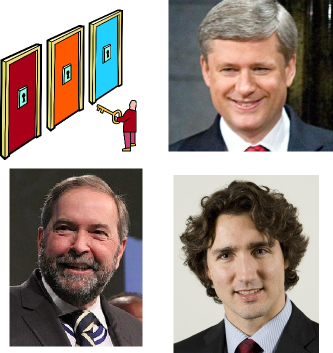
This doesn’t refer to Stevie, Tom, and Justin. The three choices are a reform of the government formation process. In a tight three way race it is not inconceivable that the party that has the most seats in a minority situation is the party that got the third most votes in the General election or worst yet a majority. What if the incumbent PM refused to step down even though their party has the third most seats but argues they got the most in the popular vote? Anyone remember December of 2008? It is all left to a patronage appointee the Governor-General to decide the issue and with the incumbent PM right there insisting they must do what ever they say or overthrow our democracy. The three choices set out clear rules what is to be done after each election.

Largest: The leader of the party with the most seats is called upon to form a government. If the seat count is equal then the one with the larger popular vote. No non-confidence motions, no vote can bring down a government. This is replaced by a motion of dissolution. By an absolute majority (170 / 338) the House can dissolve Parliament and trigger new elections. It can’t replace a government only trigger new elections. The PM can’t ask the Governor-General for early elections. It’s fixed the next election is on the set election day or an early election triggered by a motion of dissolution passed by the Commons.

House election: At the start of each Parliament the Speaker after the members of the House of Commons are sworn in asks “who should the Governor-General call upon to form a government”? The four most endorsed candidates are invited to Rideau Hall and asked to form a council-designate, a government-in-waiting. After each leader forms a proposed government of say 16 to 20 members the Speaker puts the question to the House “which of these councils-designate has the confidence of this House”? The two with the least are dropped from the second ballot. The Commons votes a second time with the winner becoming the Council of Ministers and the loser the Council of Opposition. As with the above no vote in the House triggers an election only an absolute majority passing a motion of dissolution can trigger an election before the set election day. No vote can replace the current government with another. The Council of Ministers is the government for the duration of that Parliament.

Separate election: The same as a municipal election namely a vote for a mayor, the executive election, and a vote for the councillor, the legislative election. In this case a vote for an executive council to be the government in the next Parliament and a vote for your Member of Parliament. The executive and legislative elections are separate and institute a preference ballot. If on the first count of the ballots a candidate got a majority their elected. No candidate got a majority, count the ballots a second time with only the top two being counted and the one with the majority is elected. In order for an executive council of again say 16 to 20 members to get on the ballot they must be endorsed by the candidates for the House of Commons in the last election. Each candidate has votes equal to their popular vote. The four most endorsed executive councils are on the ballot. In this there is no early elections. Parliament just like municipal elections has a fixed term and set election day.

Olivia Dorey

oliviadoreyOlivia Dorey

The budget is done in budgetese for the same reason that legal is done in legalese. The purpose is to deny outsiders the ability to understand and where possible access too the sacred writings that is restricted to only the members of the ordained priesthood. I wish her all the luck in the world she is going to need it. This is why I founded the Federalist party of Canada. If you wont to change this kind of crap you are going to have to start with the political parties themselves. In the way they are operated by insiders is no different. The tag-line says it

If you wont our politics to change you must first change our political parties.


New Brunswick Election

1024px-Flag_of_New_Brunswick.svgNew Brunswick General Election 2014 

Dual Electoral System results

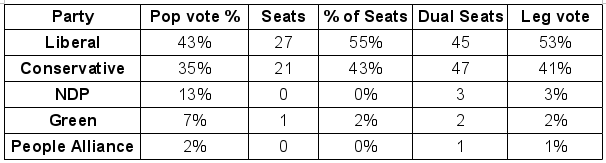
49 Ridings / 2 Members per riding / top two elected/  98 MLAs
Liberals 45 / Conservatives 47 / NDP 3 / Green 2 / PA 1

43 Ridings  Liberal / Cons
2 Ridings  Cons / NDP
1 Riding  Lib / NDP
1 Riding  Lib / Green
1 Riding  Cons / PA
1 Riding  Green / Cons

In the 43 Ridings of Liberals / Conservative I assumed the following; NDP vote goes 67% to the Liberals, Green vote goes 75% to the Liberals, and the PA & Ind vote splits 50/50.

In the following Ridings I assumed the following; Liberal vote splits 50/50, Conservative vote goes 67% to the Liberals, NDP vote goes to the Green or PA, Green vote goes to the NDP or PA, and the PA & Ind vote always splits 50/50 between the two candidates.
Restigouche-Chaleur:  Liberal / NDP
Kent North:  Liberal / Green
Hampton:  Conservative / NDP
Fredericton-Grand lake:  Conservative / PA
Fredericton South:  Green / Conservative
Fredericton – West Hanwell:  Conservative / NDP

If the above is roughly true the Legislative vote in the New Brunswick Assembly would be
Liberals 53% / Conservatives 41% / NDP 3% / Green 2% / PA 1%

Compare: First past the post  VS  Dual electoral systemsnapshot22As always I suggest forming the Legislative Assembly Advisory Council. The top two candidates in each riding are members with 1 vote in regular session. All the other candidates transfer their popular vote to one of the members from their riding  which when added to their own popular vote becomes the number of votes they have in Legislative session of the Council. The Council in regular session advises the Assembly on procedural motions. The Council in legislative session advises the Assembly on whether to pass a bill into law. The advisory council allows you to try it before you buy it.

If New Brunswick adopted the Dual electoral system the Legislative Assembly should have 25 ridings giving you 50 MLAs. This last election would probably give you 24 Liberals 55% Leg vote / 24 Cons 41% Leg vote / 1 NDP 2% Leg vote / 1 Green 2% Leg vote.

Acting president: Barry Aulis