
Tag Archives: electoral reform

One Vote Part 3

“One vote more then everyone else and you’re everything. One vote less then anyone else and you are nothing.” Barry Aulis

This is the logic of the First Past The Post electoral system. See the post One Vote below.

Windsor Tecumseh Lakeshore – Ontario

With the Dual Electoral System 3 candidates would have been elected in this Riding, the Conservative, Liberal, and NDP candidates. Depending on how the other 4 candidates transfer their votes the Riding’s 3 MPs would have the following votes when the House of Commons is in legislative session.

Kathy Borrelli: 32,090 to 33,812

Irek Kusmierczyk: 32,086 to 33,808

Alex Ilijoski: 4,240 to 5,962

The other 4 candidates would transfer their votes to one of the above or do no transfer and those votes disappear and don’t count towards the passing of legislation in the House of Commons.

Again “try it before you buy it” form the House Advisory Council composed of the top 2 candidates in each Riding with the 3rd and 4th if they got 5% of the vote. The remaining candidates transfer their votes to one of the candidates from their Riding who did get elected. They also have the option of no transfer in which case those votes disappear and don’t count towards deciding what bills get passed in legislative session.

If the Dual Electoral System was adopted reduce the number of Ridings to 300 giving you 600 to 1200 MPs of which only 300 sit in the House these are the Sitting Members of the House the rest are Non Sitting Members of the House. You could half the number of Ridings to 150 giving you 300 to 600 MPs of which again 300 would be Sitting Members and the rest being Non Sitting Members.

The Original version of the Dual Electoral System had the top 2 in each Riding being elected and the rest transferring their votes to one of these elected candidates. Hence if you keep the same number of Ridings you will double the number of members. Keep the same number of MPs and you half the number of Ridings thus doubling the number of voters each has and increasing their area covered.


One Vote Part 2

“One vote more then everyone else and you’re everything. One vote less then anyone else and you are nothing.” Barry Aulis

This is the logic of the First Past The Post electoral system. See the post One Vote below.

Terra Nova – Newfoundland & Labrador

With the Dual Electoral System 2 candidates would have been elected in Terra Nova the Liberal and Conservative candidates. Depending on how Liam Ryan transfers his votes the Riding’s 2 MPs would have the following votes when the House of Commons is in legislative session.

Anthony Germain: 19,704 or 21,381

Jonathan Rowe: 19,692 or 21,369

Liam Ryan would transfer his 1677 votes to either Germain or Rowe or do no transfer and those votes disappear and don’t count towards the passing of legislation in the House of Commons.

Again “try it before you buy it” form the House Advisory Council composed of the top 2 candidates in each Riding with the 3rd and 4th if they got 5% of the vote. The remaining candidates transfer their votes to one of the candidates from their Riding who did get elected. They also have the option of no transfer in which case those votes disappear and don’t count towards deciding what bills get passed in legislative session.

If the Dual Electoral System was adopted reduce the number of Ridings to 300 giving you 600 to 1200 MPs of which only 300 sit in the House these are the Sitting Members of the House the rest are Non Sitting Members of the House. You could half the number of Ridings to 150 giving you 300 to 600 MPs of which again 300 would be Sitting Members and the rest being Non Sitting Members.

The Original version of the Dual Electoral System had the top 2 in each Riding being elected and the rest transferring their votes to one of these elected candidates. Hence if you keep the same number of Ridings you will double the number of members. Keep the same number of MPs and you half the number of Ridings thus doubling the number of voters each has and increasing their area covered.
One Vote

“One vote more then everyone else and you’re everything. One vote less then anyone else and you are nothing.” Barry Aulis

This is the logic of the First Past The Post electoral system and the recount in Terrebonne literally just proved that statement!

With the Dual Electoral System 3 candidates would have been elected in Terrebonne; the Liberal, Bloc, and Conservative candidates. Depending on how the 3 remaining candidates transfer their votes, the Riding’s 3 MPs would have the following votes when the House of Commons is in legislative session.

Tatiana Auguste: 23,352 to 25,966

Nathalie Sinclair-Desgagné: 23,351 to 25,965

Adrienne Charles: 10,961 to 13,575

My own Riding of Compton-Stanstead would have the same result; the Liberal, Bloc, and Conservative candidates being elected with the NDP, Green, and People’s Party candidates transferring their votes to one of the 3 elected candidates.

Again “try it before you buy it” form the House Advisory Council composed of the top 2 candidates in each Riding with the 3rd and 4th if they got 5% of the vote. The remaining candidates transfer their votes to one of the candidates from their Riding who did get elected. They also have the option of no transfer in which case those votes disappear and don’t count towards deciding what bills get passed in legislative session.

If the Dual Electoral System was adopted reduce the number of Ridings to 300 giving you 600 to 1200 MPs of which only 300 sit in the House these are the Sitting Members of the House the rest are Non Sitting Members of the House. You could half the number of Ridings to 150 giving you 300 to 600 MPs of which again 300 would be Sitting Members and the rest being Non Sitting Members.

The Original version of the Dual Electoral System had the top 2 in each Riding being elected and the rest transferring their votes to one of these elected candidates. Hence if you keep the same number of Ridings you will double the number of members. Keep the same number of MPs and you half the number of Ridings thus doubling the number of voters each has and increasing their area covered.
Alberta election 2023

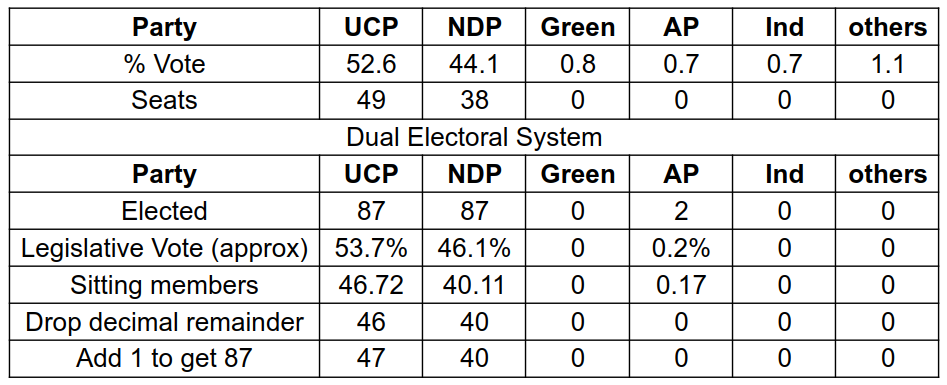
The last Alberta provincial election 2023 by the Dual Electoral System.

The top 2 candidates are elected with the third or fourth also elected if they got 5% of the vote. All other candidates transfer their vote to one elected in their riding or let it not get represented. Each riding is represented by 2 to 4 MLAs.

All these legislators only vote when the Assembly is in legislative session every Wednesday afternoon. The 87 sitting MLAs are elected by party lists voted on by the MLAs. Each party will elected sitting members equal to their legislative vote.

The top two candidates in every riding were the UCP and the NDP. No fourth place candidate got 5% of the vote but 2 third place candidates did, both the Alberta Party, in the ridings of Brooks-Medicine hat and LaCombe-Ponoka.

After calculating for the sitting members you drop the decimal then add members to get the number of sitting members. You add 1 to each list in order of the highest decimal remainder. For the party lists the party candidates are ordered from highest percentage of the vote to lowest. So for the UCP it would be the 47 candidates with the highest percentage of the vote who get to sit in the Legislative Assembly and the top 40 for the NDP.

Fair vote National council

Fair_Vote_Canada_logoI’m one of 15 candidates in the 2016 election for 8 seats on the National council for Fair vote Canada. To any members of Fair vote Canada, welcome! Any questions just ask email is president@federalistparty.ca.

I founded the Federalist Party in 2009 because none of the other parties had something I wanted (and I looked at all of them). This being a National Assembly of a Party that uses the new tools of the Internet to innovate the process of party governance. An online, duly constituted, deliberative,  rank and file members, parliamentary body that uses the Internet to debate and discuss and has online voting to render it’s decisions. I worked on a farm at the time and we all can’t just get away to attend meetings or conventions. Instead why don’t we……………. and the Federalist party of Canada. The other parties particularly the Conservatives and Liberals had a lot of things I didn’t like. If you want things done right, do it yourself, so I did. The purpose not being to put myself in a leadership position and not to have the policies I want but rather to belong to a Party that has a “National Assembly” where I as a activate rank and file member can participate and vote. Most importantly this body’s approval is required for all resolutions, all national by-laws,  and it and only it can amend the constitution of the Party. If it seems I have a chip on the shoulder it’s because I do and these are the people that charge things. Because the status quo is no longer acceptable and the great reformers are the ones that come up with the answer to the question “If not this, then what”? Thanks for the time Acting president Barry Aulis.