
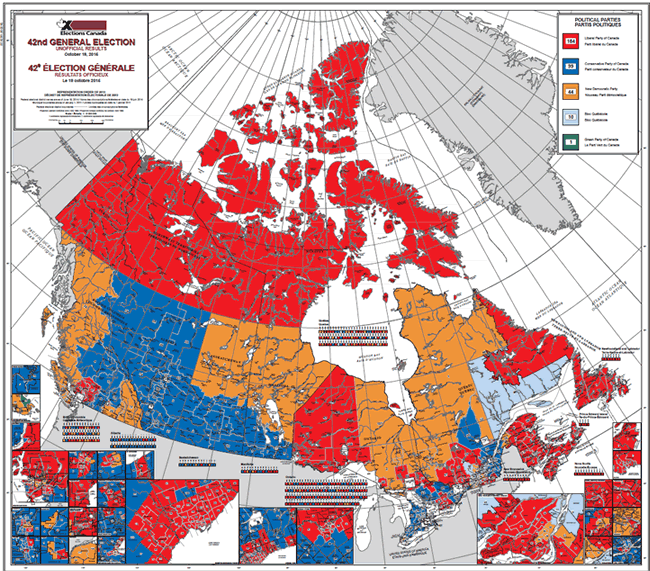
 I advocate the adoption of the Dual Electoral System with the number of seats set at 150. This giving a House of Commons of 300 members. After each election the percentage of eligible voters out of the national total is determined for each province and territory. This is used to determine the number of seats to be allotted to 2 decimal places. The decimal remainder is dropped giving you less the 150 seats. Any province or territory that has 0 seats is given 1 seat. All provinces and territories are guaranteed at least 1 seat. If the number of seats is still less then 150 then additional seats are allotted to a province or territory in order of the highest remainder first till 150 is reached.
|
Province / Territory |
Eligible voters |
150 seats |
Additional |
Seats / MPs |
|
British Columbia |
3,340,830 |
19.55 |
19 / 38 |
|
|
Alberta |
2,791,346 |
16.33 |
16 / 32 |
|
|
Saskatchewan |
765,102 |
4.48 |
4 / 8 |
|
|
Manitoba |
873,492 |
5.11 |
5 / 10 |
|
|
Ontario |
9,560,745 |
55.94 |
+1** |
56 / 112 |
|
Quebec |
6,373,482 |
37.29 |
37 / 74 |
|
|
New Brunswick |
592,925 |
3.47 |
3 / 6 |
|
|
Nova Scotia |
736,008 |
4.31 |
4 / 8 |
|
|
PEI |
112,975 |
0.66 |
+1* |
1 / 2 |
|
Newfoundland |
416,536 |
2.44 |
2 / 4 |
|
|
Yukon |
26,283 |
0.15 |
+1* |
1 / 2 |
|
NWT |
29,432 |
0.17 |
+1* |
1 / 2 |
|
Nunavut |
19,223 |
0.11 |
+1* |
1 / 2 |
|
Total |
25,638,379 |
145 |
+5 |
150 / 300 |
*Additional to have at least 1 seat
**Additional to bring seat total to 150.
Instead of a full revision of the electoral map every 10 years you have a partial revision after each election. The smallest riding in a province or territory must be at least 50% of the number of voters of the largest riding in that jurisdiction. Because you can have the ridings with a greater spread in number of voters you don’t have to have ridings within a narrow range. A province or territory that gains or loses seats will have some boundaries redrawn. A jurisdiction that doesn’t change in the number of seats might have some ridings redrawn to keep ridings within the range of 50% of the largest in that province or territory.
 The Federalist party of Canada