Tag Archives: dual electoral system

PEI General Election 2015

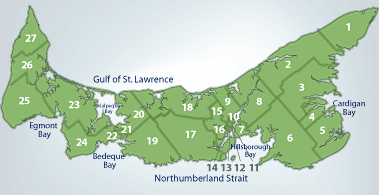
pei_mapAgain the disproportionate results produced by the first past the post system. A big majority votes against a Party yet they get a super majority of the seats and votes in the legislature. In the last PEI Provincial legislature I mailed, YES! the Canada post kind, all the MLAs with a letter detailing the Dual Electoral System. That system is again stated in a recent post on the Party blog of the Federalist party of Canada.

Voting is done by a preference ballot. On the first count of the ballots the top two candidates in each riding are elected. On the second count of the ballots the elected candidates get one vote for every ballot they have the lower number on. All the votes cast for the candidates who did not get elected are transferred to one of the top two candidates in that riding.

In the Legislature each member has one vote in regular session. In legislative session they have one vote for each of the votes they received on the second count of the ballots. The Legislature goes into legislative session every Thursday at 1 PM and during that session any bills up for a vote that week are voted on and passed or defeated. Any bills that were adopted by the Assembly are on the desk of the Lieutenant-Governor Friday morning for Royal assent.

In regular session in the last Legislature it would have been 50% Liberal and 50% PC. The operation of the Assembly is done on a non-partisan basis for no one party can gain a majority. In legislative session the Liberals would have had a solid majority and there is your proportional representation.

Try it before you buy it. Form the Legislature advisory council. The members are the top two candidates from each riding. Each member has the one vote in regular session of the council. All of the candidates not on the council transfers their votes to one of the council members from their riding. All votes do get represented. These are voted when the council is in legislative session. Regular session votes advise the Assembly on procedural votes and in legislative session on votes to pass legislation.

If PEI adopted the Dual Electoral System have 15 ridings for 30 members or 12 ridings for 24 members.

PEI Election 2015: What the Legislature advisory council would look like.

Party

Popular vote

Seats

Dual seats

Dual votes

Liberal

41%

18 / 67%

27 / 50%

42% – 62%

PC

37%

8 / 30%

26 / 48%

36% – 56%

NDP

11%

0 / 0%

0 / 0%

0%

Green

11%

1 / 4%

1 / 2%

2%

It is where the Green and NDP vote goes whether to the Liberal candidate or the PC candidate that would determine who gets a possible majority in the Assembly. If the Liberals get half they would have 52% of the legislative vote under the Dual Electoral System. Even if they got a 2/3 majority of these votes they would have 55% of the legislative vote.

59% vote against the Liberals and they get 67% of the seats. Time for a change. Time to try it before you buy it with the Dual Electoral System.

Dual Electoral System for PEI

15 RiWade-MacLauchlan_0dings that elect the top two candidates in each riding giving you 30 MLAs. A preference ballot is used and is counted a second time with only the two elected candidates from the first count being tallied. They get one legislative vote for each ballot they have the lower number on. Each MLA has one vote in regular session where the work of the Legislature is done and when procedural motions are voted upon. For this last Legislature that’s 15 Liberals and 15 Conservatives. The Legislative Assembly is operated on a non partisan bases. In legislative session each MLA has one vote for every vote they received on the second count of the ballots. The Assembly goes into legislative session every Thursday afternoon at 1 PM to vote on any legislative motion to be passed. Any bills approved then go to the Lieutenant-Governor for royal assent on Friday morning.

Try it before you buy it. In this next Legislature form the Assembly advisory council. The council membership is the top two candidates from each riding giving you 54 members. In the regular vote each member has one vote. The regular vote advises the Legislative Assembly on procedural motions, election of the Speaker, and Assembly rules. In the legislative vote of the council each member has votes equal to their popular vote. All candidates not on the council transfer their popular vote to one of the two members from their riding. All votes do count! The legislative vote advises the Legislative Assembly on votes to adopt legislative motions.

The Legislative Assembly elected in 2011 the council would have been 27 Liberals with about 52% – 59% of the legislative vote. The Conservatives with 27 members with 41% – 48% of the legislative vote. A few years ago I mailed all the PEI MLAs letters (the Canada post kind) detailing the dual electoral system. Got back one reply.

New Brunswick Election

1024px-Flag_of_New_Brunswick.svgNew Brunswick General Election 2014 

Dual Electoral System results

49 Ridings / 2 Members per riding / top two elected/  98 MLAs
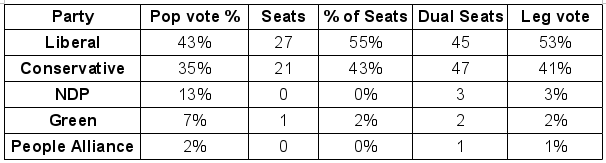
Liberals 45 / Conservatives 47 / NDP 3 / Green 2 / PA 1

43 Ridings  Liberal / Cons
2 Ridings  Cons / NDP
1 Riding  Lib / NDP
1 Riding  Lib / Green
1 Riding  Cons / PA
1 Riding  Green / Cons

In the 43 Ridings of Liberals / Conservative I assumed the following; NDP vote goes 67% to the Liberals, Green vote goes 75% to the Liberals, and the PA & Ind vote splits 50/50.

In the following Ridings I assumed the following; Liberal vote splits 50/50, Conservative vote goes 67% to the Liberals, NDP vote goes to the Green or PA, Green vote goes to the NDP or PA, and the PA & Ind vote always splits 50/50 between the two candidates.
Restigouche-Chaleur:  Liberal / NDP
Kent North:  Liberal / Green
Hampton:  Conservative / NDP
Fredericton-Grand lake:  Conservative / PA
Fredericton South:  Green / Conservative
Fredericton – West Hanwell:  Conservative / NDP

If the above is roughly true the Legislative vote in the New Brunswick Assembly would be
Liberals 53% / Conservatives 41% / NDP 3% / Green 2% / PA 1%

Compare: First past the post  VS  Dual electoral systemsnapshot22As always I suggest forming the Legislative Assembly Advisory Council. The top two candidates in each riding are members with 1 vote in regular session. All the other candidates transfer their popular vote to one of the members from their riding  which when added to their own popular vote becomes the number of votes they have in Legislative session of the Council. The Council in regular session advises the Assembly on procedural motions. The Council in legislative session advises the Assembly on whether to pass a bill into law. The advisory council allows you to try it before you buy it.

If New Brunswick adopted the Dual electoral system the Legislative Assembly should have 25 ridings giving you 50 MLAs. This last election would probably give you 24 Liberals 55% Leg vote / 24 Cons 41% Leg vote / 1 NDP 2% Leg vote / 1 Green 2% Leg vote.

Acting president: Barry Aulis

Nova Scotia Election

Nova_ScotiaIn the recent provincial election in Nova Scotia the Liberals got 65% of the seats with 45% of the vote so much for representative. Here’s a comparison using the dual electoral system.

Dual Electoral System: A preference ballot is used for voting. The candidate with the number one on a ballot gets one vote. The two candidates with the most votes are elected. The ballots are counted a second time with the elected candidate with the lower number getting one vote. Each elected member will have one ” member vote ” in the House to be used in regular sessions and one ” legislative vote ” for each vote received on the second count of the ballots. These votes are voted when the House is in legislative session and is used to pass what else, legislation! One day a week is set by the Assembly for the legislative session and any bills requiring third reading are voted on during that session. http://thegreybook.wikispaces.com/Dual+electoral+system

Party

% Vote

Seats

Dual Seats

Legislative votes

Liberal

45%

33

44

51% +/- 2%

NDP

27%

7

34

26% +/- 2%

Conservatives

27%

11

24

23% +/- 2%

Chile

I’ve justFlag_of_Chile.svg emailed the following to the members of the National congress of Chile that’s all 120 members of the Chamber of Deputies and the 38 members of the Senate.  Chamber of Deputies  Senate

Traducción por google

Soy el fundador del partido federalistade Canadá.

Creo que usted estará interesado en el sistema electoral de doble.

http://thegreybook.wikispaces.com/Dual+electoral+system

Le saluda atentamente, Barry Aulis.