
Michael Chong vs Federalist Party

Coke-vs-Pepsi5Michael Chong’s Bill  vs  Federalist constitution

Bill C-559

National constitution

MC  65.1 Nomination contests shall be held by the registered association for the electoral district to which the nomination relates at a time and date fixed by the association and in accordance with the rules established by the association.

FP  10.2 The National Assembly and the National Congress in regular session by two-thirds majority votes shall pass a Federal Election bylaw to govern all national and nomination elections of the Party.

MC  (c) if applicable, an instrument in writing, signed by the nomination officer of the political party’s electoral district association for the electoral district that states that the prospective candidate is endorsed by the party.

FP  11.3 The Leader shall sign all nomination and Election Canada papers. Any refusal shall mean the automatic and immediate expulsion from the Party.

MC  A prospective candidate for a political party in an electoral district must be endorsed by the nomination officer of the party’s electoral district association of the party in that electoral district.

FP  10.5 There shall be a Federal Election Officer (FEO). This officer shall be responsible for the conduct of all national and nomination elections and the administration of the Party’s registered voters list.

MC  (2) The nomination officer referred to in subsection (1) shall be appointed by the members of the electoral district association by a majority vote.

FP  10.6 The Federal Election Officer is elected by a two-thirds majority vote of the National Congress in regular session with a concurring two-thirds majority vote of the National Assembly. This officer can be removed by the same vote in the Assembly and Congress. The term of office shall be for 10 years.

MC  (i) a leadership review may be initiated by the submission of a written notice to the caucus chair signed by at least 15% of the members of the party’s caucus,
(ii) a leadership review is to be conducted by secret ballot, with the result to be determined by a majority vote of the caucus members present at a meeting of the caucus, and
(iii) if a majority of caucus members present at the meeting referred to in subparagraph (ii) vote to replace the leader of the party, a second vote of the caucus shall be conducted immediately by secret ballot to appoint a person to serve as the interim leader of the party until a new leader has been duly elected by the party.

FP  5.8 By a majority vote in the National Assembly and an absolute majority in the National Congress in regular session any member may be suspended or dismissed from the Federal Council. This can also dismiss or suspend the Leader or Deputy leader.

MC  49.2 A member of a caucus may only be expelled from it if
(a) the caucus chair has received a written notice signed by at least 15% of the members of the caucus requesting that the member’s membership be reviewed at a meeting of the caucus; and
(b) the expulsion of the member is approved by a majority vote by secret ballot of the caucus members present at that meeting.

49.4 (1) After every general election or following the death, incapacity, resignation or removal of the chair of a caucus in accordance with subsection (2), a chair shall be elected by a majority vote by secret ballot of the members of that caucus who are present at a meeting of the caucus.

(b) the removal of the chair is approved by a majority vote by secret ballot of the caucus members present at that meeting.

FP  11.4 The House caucus shall consist of all Party members who are members of the House of Commons. The caucus by an absolute two-thirds majority vote can suspend an MP from caucus. The Senate caucus shall be the same as the House caucus with the two making the Parliament caucus.
11.5 The House leader shall be elected by a secret vote of the House caucus. The runner-up in such a vote becomes deputy House leader. These two officers are members of the Federal Council. The Party caucus in the Senate shall do the same.
Independent prosecutor

whThe continuing scandal with the Senate of Canada shows the need for an independent prosecutors office to handle investigations into the conduct of those in government. To use what is happening with Mayor Ford as an example Toronto should establish a prosecuting office with sole responsibility of investigating any official of the municipal government of Toronto.

The Toronto Metropolitan Office of Investigation

There would be 8 senior prosecutors in the Office of Investigation. These prosecutors are the ones to initiate and direct any investigation into the operation of the city government and the conduct of any of its officials. After each municipal election 4 senior Prosecutors are appointed for a term of 8 years or for the duration of 2 elections. This gives you 8 prosecutors with half appointed every 4 years.

Appointment

One is appointed by the Mayor-elect and one appointed by the runner-up in the mayoral election. Two are elected by the city council by secret preference ballot with the top two candidates getting elected. Each of the appointed prosecutors can have their appointment rescinded by a two thirds majority vote of the city council. Each of the elected prosecutors can have their appointment rescinded by a joint veto issued by the mayor-elect and the second placed candidate. A prosecutor can be removed after taking office by a motion of dismissal introduced by the Mayor and the runner-up mayoral candidate and passed by an absolute two thirds majority of the council.

Preliminary

One prosecutor can start a preliminary investigation into the conduct of anyone in the municipal government of Toronto. This investigation is to last 30 days. Another prosecutor can extend the preliminary investigation another 60 days and a third prosecutor a further 90 days after that for a total of 180 days. Any official of the city of Toronto can refuse to testify under oath or provide documents or records by a signed statement of refusal. Refusal to provide either is an offense and the penalty is loss of salary until the official provides the evidence or issues a statement of refusal.

Official

Two prosecutors can initiate an official investigation that has the authority to subpoena witnesses and documents from the municipal government. This investigation is to last 3 months. If three prosecutors authorize the official investigation then its duration is 6 months and with four prosecutors it shall last 1 year. An official investigation can require testimony or evidence from Canadian citizens with their right to refuse by a statement of refusal. Failure to provide either the evidence or a statement of refusal will be a prosecutable offense.

Inquiry

Four prosecutors can open an official inquiry with full authority to investigate and lasts for 12 months and each additional prosecutor who supports the official inquiry extends the term by 6 months with it lasting up to 3 years with the support of all 8 metropolitan prosecutors.

The police merely execute search warrants and the like and do not conduct investigations into political corruption thus keeping them out of it. I think the RCMP has better things to do with their time then looking at PMO emails. Investigations are kept separate from the politicians and Parliament. No Saturday night massacres or referral of changes by the PMO.

The U.S. had an independent prosecutors office but the politicians got rid of it story here. Which is the lesser of two evils the witch hunt or the cover up? The politicians clearly prefer the cover up. I prefer the witch hunt because there’s no such thing as witches. I accept the possibility of an unfair prosecution but if there is nothing there then there is nothing there!

Michael Chong

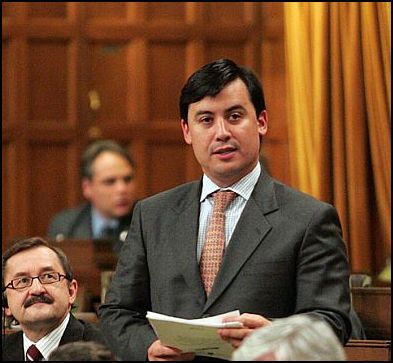
Michael Chong MPMichael Chong MP for Wellington—Halton Hills has introduced a private members bill story here.

If you wont to change our politics you must first change the political parties.

I sent Mr. Chong the following email.

I read with interest about your private members bill it mirrors what has been done in the provisional constitution of the Federalist party of Canada.
The National Assembly is the members of the party who’ve registered to vote in the Assembly. The National congress is the candidates for the House of Commons. I think you might be interested in the following articles from the constitution.

5.8 By a majority vote in the National Assembly and an absolute majority in the National Congress in regular session any member may be suspended or dismissed from the Federal Council. This can also dismiss or suspend the Leader or Deputy leader.

11.3 The Leader shall sign all nomination and Election Canada papers. Any refusal shall mean the automatic and immediate expulsion from the Party.

11.4 The House caucus shall consist of all Party members who are members of the House of Commons. The caucus by an absolute two-thirds majority vote can suspend an MP from caucus. The Senate caucus shall be the same as the House caucus with the two making the Parliament caucus.

11.5 The House leader shall be elected by a secret vote of the House caucus. The runner-up in such a vote becomes deputy House leader. These two officers are members of the Federal Council. The Party caucus in the Senate shall do the same.

12.3 Key resolutions need two third majorities to be passed in the National Assembly, National Congress, and the Federal council. Key resolutions are motioned in the National policy committee. These resolutions form the National Party Platform and are binding upon a Federalist government and all Federalist MPs. Each Federalist MP can vote as they choose in the House of Commons. They may vote against a key resolution without penalty a number of times in each Parliament equal to the number of times they have been elected to the Commons.

Thanks Barry.

And nothing changes

45adc339c8799cb8b5104bade9230c6aAs you find from the table in three of the four by-elections the winning candidate won by a plurality and only one got a majority. Combined the winning candidates got less then 50% of the votes cast. With the Dual Electoral System the top two get elected and the votes cast for all others will go to one of these two elected candidates. In the by-elections the top two candidates got 85% of the votes cast so those voters get represented by their first choice and the other 15% of the vote will go to one of these so those voters get represented in Parliament by a secondary choice for MP.

Elected

Top two

Others

Bourassa

48%

79%

21%

Brandon-souris

44%

87%

13%

Provencher

58%

88%

12%

Toronto-centre

49%

85%

15%

All four ridings

49%

85%

15%

The Nuclear Option

nuclear-bomb-explosion

The nuclear option / CNN

I remember the nomination of Judge Bork to the Supreme Court by Pres. Ronald Reagan in the 80s. The nomination was opposed by the Democratic majority in the Senate and was rejected by the Senate. During this process I remember thinking that the Senate has every right to confirm the appointment, every right to reject the appointment, but no right to delay or abstain from making a decision on the appointment. With the Senate rule requiring 60 votes to end a filibuster this gives the minority the ability to block a decision made by a majority of the Senate. The majority has every right to pass a motion and every right to reject a motion but the minority has no right to prevent the majority from doing one or the other.

In the Senate rules dealing with nominations there should be five set days on which the Senate shall vote to confirm or reject any nomination.

  • The default day shall be the first daily sitting of the Senate that is 30 days after the nomination by the president.
  • By the vote of 67 senators the nomination vote will be the first daily sitting of the Senate that is 10 days after the nomination.
  • By a vote of 60 senators the nomination vote will be the first daily sitting of the Senate 20 days after the nomination.
  • By a vote of 34 senators the nomination will be voted on the first daily sitting of the Senate 45 days after the nomination.
  • By a vote of 50 senators the nomination will be voted on the first daily sitting of the Senate 60 days after the nomination.

This process gives you a default vote on a nomination 30 days after the appointment. By super majorities the Senate can vote earlier than the 30 days and by minorities can hold the vote later than those 30 days. The Senate shall hold a confirmation vote on a nomination on one of five set days they being 10 days, 20 days, 30 days, 45 days, and 60 days after the appointment by the president. If you wish to keep needing 60 votes to get to a vote on a nomination then have the rules state you need 60 votes to confirm not a simple majority.

The power of Democracy is vested in the majority and in the minority it’s principle

From the National Congress webpage.

Acting president  Barry Aulis