Official Party (UK version)


Out of curiosity, if the UK adopted the Official Party rule which Parties would have official status? These are all the Parties that got at least 1% of the vote in the last 3 elections. Votes are in the millions and is the total of the votes received in the last 3 general elections in 2017, 2019, and 2024.

In all of the last 3 general elections the Conservatives, Labour, and the Liberal Democrats got 5% of the vote. The Green Party only got 5% in the last election. UKIP/Reform got 5% in the last election, also in 2015, but not in the 2 elections in between.

Prior to the 2024 election the UK would have had 4 Official Parties; Conservative, Labour, Liberal Democrat, and UKIP. After this last election the Green party would have official status as well bringing the total up to 5 Official Parties.

Percentages


If you took the percentage each Party got in every province and added it up, divided by 10, what would you get? The average provincial popular vote and how would this compare to the national popular vote? Take a look and I was very surprised by the result.

Little nugget

An interesting statistical nugget from the election, the combined Liberal / Conservative vote in 2021 was 67% with the Conservative’s holding 51%. The Conservative’s got 34% of the vote to the Liberal’s 33% of the vote in that election.

This election the Liberal / Conservative vote was 85% of the total with the Liberal’s having the majority at 52%. The Liberal’s got 44% to the Conservative’s 41% of the vote.

More interesting is the increase of the combined share of the vote. The two Parties share went from 67% to 85%, an 18 percentage point increase. The Liberal’s went up 11 points, the Conservative’s 7 points, meaning the Liberal’s got 60% of this increase in the combined vote.

Non voting members

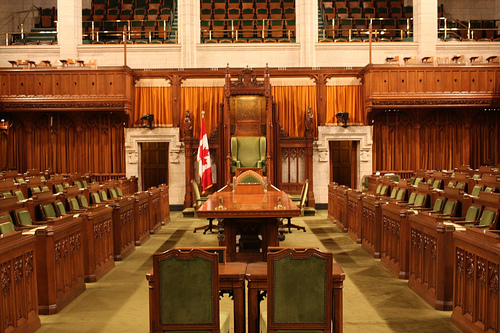
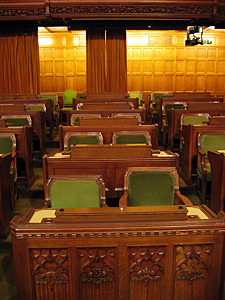
All Leaders of Official Parties should be given a non-voting seat in the House of Commons. Check the post below and Canada has 5 Official Parties; Liberal, Conservative, NDP, Bloc, and the Green Party. Poilievre will not have to ask someone to step aside and trigger an unnecessary by-election and the new Leader of the NDP, when elected, will get to be in the House should they not be an MP.

Non-voting members do not vote, do not sit on any subsidiary body of the Commons, but can motion and speak in the House. US House of Representative’s non-voting members do sit on and vote in committee. These Territorial delegates do not vote on the House floor.

Alberta election 2023

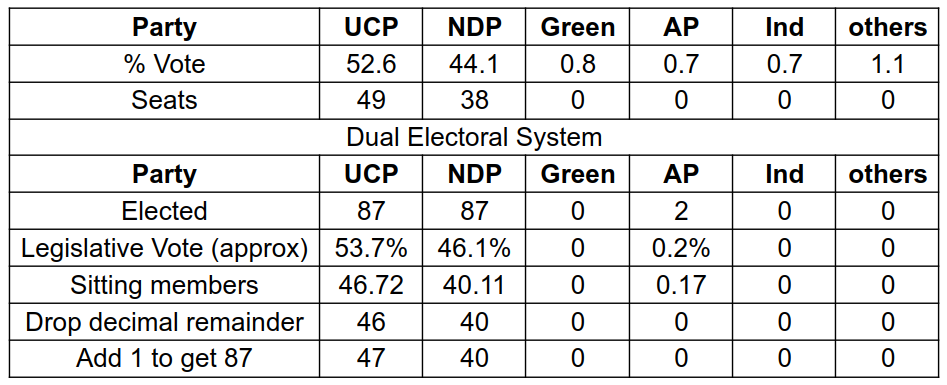
The last Alberta provincial election 2023 by the Dual Electoral System.

The top 2 candidates are elected with the third or fourth also elected if they got 5% of the vote. All other candidates transfer their vote to one elected in their riding or let it not get represented. Each riding is represented by 2 to 4 MLAs.

All these legislators only vote when the Assembly is in legislative session every Wednesday afternoon. The 87 sitting MLAs are elected by party lists voted on by the MLAs. Each party will elected sitting members equal to their legislative vote.

The top two candidates in every riding were the UCP and the NDP. No fourth place candidate got 5% of the vote but 2 third place candidates did, both the Alberta Party, in the ridings of Brooks-Medicine hat and LaCombe-Ponoka.

After calculating for the sitting members you drop the decimal then add members to get the number of sitting members. You add 1 to each list in order of the highest decimal remainder. For the party lists the party candidates are ordered from highest percentage of the vote to lowest. So for the UCP it would be the 47 candidates with the highest percentage of the vote who get to sit in the Legislative Assembly and the top 40 for the NDP.