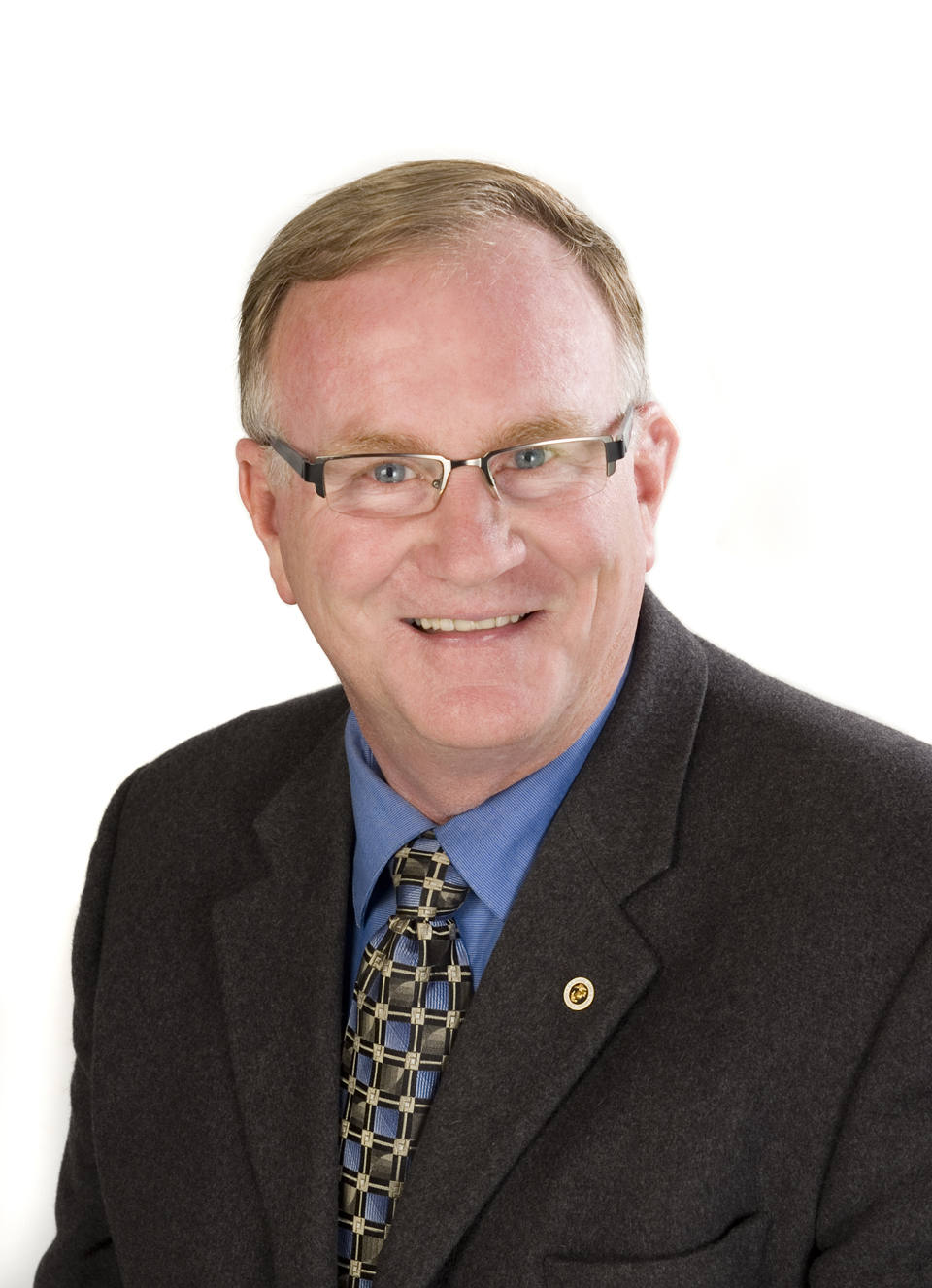
Joe Anglin

Joe Anglin

Mr Anglin quit the Wildrose party of Alberta for basically the same reasons I quit the federal NDP and founded this the Federalist party of Canada. Below is the statement Mr. Anglin put out on his Facebook page.

Founder Barry Aulis

CBC Story

I have written the Speaker of the Assembly, the Hon. Gene Zwozdesky this morning and requested that I be seated as an independent MLA, effective immediately.

It is no secret that I have been a round peg in a square hole in the Wildrose Party. I speak my mind. I bring different experiences and a different point of view to the caucus than my colleagues. This has never been an issue for me: a strong party is made stronger by a variety of opinions. A party that wants to govern a province as big and diverse as ours must be a big tent.

I also believed then – as I do now – that a change of government was one of the most important policies of all. On that point, we were united in our common cause: constructing a real alternative to the Redford government.

Unfortunately, that unity wasn’t destined to last. Behind closed doors, the party has increasingly lost focus on its original mission of creating a true grassroots party. It has been caught up in a civil war between ideologues and pragmatists, with staff, volunteers, and even MLAs being placed into and forced out of positions with alarming frequency. As a result of poor management and infighting, there will be a motion today by my leader, Danielle Smith, to have me removed from caucus. To be honest, this is upsetting but not surprising. It was clear by the way the party executive mishandled my nomination process last June, and by the way they mismanaged the past four by-elections something needs to be corrected.

The Wildrose Party is now at a crossroads. The Party’s interference in local constituency matters and its lack of respect for the democratic process must be corrected if this party is to continue. While I am proud to have worked with my caucus colleagues, and share in their many accomplishments, the party and its leadership are in crisis.

This party was founded on the principles of a grassroots democracy. It is now infested with an unelected backroom weed that is choking off the grassroots movement. I still have the highest regard for Danielle Smith as a person. She is intelligent and thoughtful, but in saying this I have little respect for the people advising her. Ultimately the leader bears the responsibility for addressing these problems.

There is however a silver lining to this cloud. We have seen in just this last week the support Albertans are willing to give on the promise of new management. The Wildrose Party could take a page out of that playbook!

I stand for better government before party politics. Always have, always will! I will serve my constituents, champion the values I hold dear and try to improve our government.
New Brunswick Election

1024px-Flag_of_New_Brunswick.svgNew Brunswick General Election 2014 

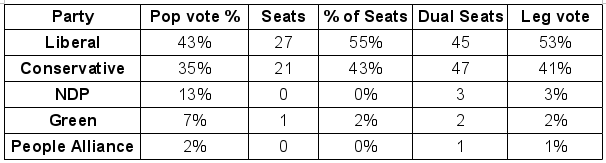
Dual Electoral System results

49 Ridings / 2 Members per riding / top two elected/  98 MLAs
Liberals 45 / Conservatives 47 / NDP 3 / Green 2 / PA 1

43 Ridings  Liberal / Cons
2 Ridings  Cons / NDP
1 Riding  Lib / NDP
1 Riding  Lib / Green
1 Riding  Cons / PA
1 Riding  Green / Cons

In the 43 Ridings of Liberals / Conservative I assumed the following; NDP vote goes 67% to the Liberals, Green vote goes 75% to the Liberals, and the PA & Ind vote splits 50/50.

In the following Ridings I assumed the following; Liberal vote splits 50/50, Conservative vote goes 67% to the Liberals, NDP vote goes to the Green or PA, Green vote goes to the NDP or PA, and the PA & Ind vote always splits 50/50 between the two candidates.
Restigouche-Chaleur:  Liberal / NDP
Kent North:  Liberal / Green
Hampton:  Conservative / NDP
Fredericton-Grand lake:  Conservative / PA
Fredericton South:  Green / Conservative
Fredericton – West Hanwell:  Conservative / NDP

If the above is roughly true the Legislative vote in the New Brunswick Assembly would be
Liberals 53% / Conservatives 41% / NDP 3% / Green 2% / PA 1%

Compare: First past the post  VS  Dual electoral systemsnapshot22As always I suggest forming the Legislative Assembly Advisory Council. The top two candidates in each riding are members with 1 vote in regular session. All the other candidates transfer their popular vote to one of the members from their riding  which when added to their own popular vote becomes the number of votes they have in Legislative session of the Council. The Council in regular session advises the Assembly on procedural motions. The Council in legislative session advises the Assembly on whether to pass a bill into law. The advisory council allows you to try it before you buy it.

If New Brunswick adopted the Dual electoral system the Legislative Assembly should have 25 ridings giving you 50 MLAs. This last election would probably give you 24 Liberals 55% Leg vote / 24 Cons 41% Leg vote / 1 NDP 2% Leg vote / 1 Green 2% Leg vote.

Acting president: Barry Aulis

Revere the Leader

abortion-rights-trump-mps-freedom-to-vote-their-conscienceliberal-caucus-20140819Jus In the natural governing party you revere the Leader. The Liberals have learned nothing and its still the same old same old. But are any of the other parties any better?

12.3 Key resolutions need two third majorities to be passed in the National Assembly, National Congress, and the Federal council. Key resolutions are motioned in the National policy committee. These resolutions form the National Party Platform and are binding upon a Federalist government and all Federalist MPs. Each Federalist MP can vote as they choose in the House of Commons. They may vote against a key resolution without penalty a number of times in each Parliament equal to the number of times they have been elected to the Commons.

I have had this discussion before and what it comes down too is are you a Member of Parliament or are you a Member of Party? The answer is another more basic question the voters and taxpayers of Canada should ask. Who pays their salaries?

With the Federalist party of Canada what comes first is recognition that its the taxpayers who pay an MP’s salary and not the Party and certainly not the Party Leader. But they are also running as the Federalist’s candidate for the House so they are required to support the Party’s platform in Parliament. This support however is not and should not be the absolute that Mr. Trudue is dictating to the members of the Liberal party.

As the Federalist party’s constitution shows Federalist’s MPs can pass on a bloc vote of the caucus a limited number of times in each Parliament. Breaking party ranks beyond this brings the following penalties; first time 90 day suspension from caucus, second time 180 day suspension from caucus and National Congress, third time 1 year suspension of party membership, fourth time its bye bye you are in the wrong party!

Instead of Party discipline rigidity have a system that says you are both MP Member of Parliament and a Member of your Party. I repeat you are a Member of Parliament first why? Because where I come from the One that pays your salary is the one who gets to call the shots!

Barry Aulis

Dear Mr. Prentice

http://wwjim-prenticew.cbc.ca/news/canada/calgary/4-challenges-facing-jim-prentice-1.2758876

Here’s an idea for Premier Prentice. This is a proposed policy resolution.

Introduction
Non-voting members of the House of Commons
Under the standing orders of the House of Commons there shall be created a class of members called House delegates who can motion and debate but have no seat on any committee and no vote in the House of Commons.

Be it resolved
Delegates can be created by an absolute two-thirds majority vote (206) of the Commons. These delegates have a term of office for the duration of that parliament. A House delegate called a Member-emeritus can be created by an absolute three quarters majority vote (231) of the Commons. A Member-emeritus serves for the duration of five parliaments starting with the one in which they are created. All Speakers of the House become a Member-emeritus for life in the Parliament after they retire.

Be it further resolved
There shall be ex-official House delegates who are any member of the Council of Ministers or the Council of Opposition who does not have a seat in the House of Commons. Furthermore both the Prime Minister and the Leader of the Opposition shall only be House delegates. If they are members of the House of Commons at the time of appointment as Prime minister or Leader of the opposition they then shall resign that seat in the House of Commons. Also if any leader of an official political party does not have a seat in the House of Commons they shall become a delegate member of the Commons. The status of an official political party shall be granted to any party, which got 5% or more of the popular vote
in the last election or who has 1% or more of the membership in the House of Commons.

By appointment as Premier of Alberta Mr. Prentice also becomes an Assembly delegate in the Alberta legislature. As for his idea for terms limits from the Federalist party’s constitution and Bylaws.

11.0 The Party shall hold a leadership election no earlier then 3 years after the last vote and no later then 6 years after the last leadership election. The winner is elected Leader of the Party and the runner-up as the Deputy leader.

11.1 It is a vote in the National Congress in regular session that sets the month for the leadership vote. The Leader may serve at most 3 terms as Leader of the Party.

That members of the Federalist party be barred from running for the party’s nomination for the House of Commons if they have served as an MP in 6 Parliaments or have been the Federalist’s candidate 8 times.

New Brunswick Election

1024px-Flag_of_New_Brunswick.svgThe Dual Electoral System is inspired from the House of Commons where you have a Leader representing the majority of the House and a Leader representing the largest minority of the House. Voting is conducted by a secret preference ballot where the voters mark the candidates in order of choice (1, 2, 3, 4, etc). The ballots are counted with the two candidates with the most votes getting elected. The ballots are counted a second time where the elected candidate with the lower number gets one Legislative vote for every vote received on the second count. In regular session each member has one vote which for the last New Brunswick General election would give both the PC and Liberals one vote less then 50%. The Legislature would operate on a consensual basis because no party can get a majority in regular session. The legislature would have a legislative session once a week where any bills requiring approval are voted on. Each member would have votes equal to their popular vote in their riding. All votes do count in an election for one of the elected candidates from your riding will receive your vote and cast it in Legislative session to determine the passage of legislation.

nb1

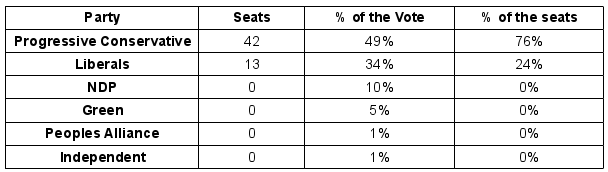
As the first table shows in the last General Election in New Brunswick ended with the PCs getting 76% of the seats though a majority of the voters voted against the conservatives. Also 17% of the voters voted for parties that gained no seat and so all those voters have no representation of any kind in the Legislature. The phrase “Taxation without Representation” comes to mind.

nb2

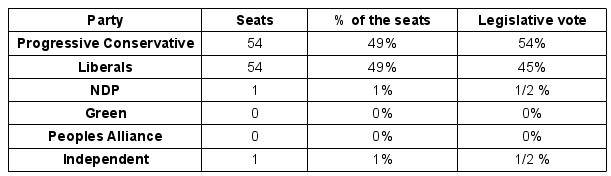
The second table shows the results using the Dual Electoral System. The top two candidates in each riding are elected. This gives both the Conservatives and Liberals the same number of seats and one seat shy of 50%. In regular session its one member one vote so no party rules the Legislature. In the riding of Woodstock the top two candidates were the PC candidate and an Independent Mr David Allen. In the riding of Tracadia-Shelia the top two candidates were the candidates for the Liberals and the NDP. In all other riding’s the top two candidates belonged to the PC and Liberals.

In Legislative session for the riding’s that elected the PC and Liberal candidates I made the assumption that 2/3 of the remaining vote would go Liberal and 1/3 to the PC. For the riding of Woodstock I decided all the secondary vote goes to the Independent candidate Mr David Allen. For the riding of Tracadia-Shelia I awarded all the votes for the PC to the Liberals and none to the NDP. The Legislative vote that the PC and Liberal parties would have better reflects the way the voters voted; PC 54% Leg / 49% Pop, Liberal 45% Leg / 34% Pop. Also all the votes cast for the other candidates just doesn’t disappear they go somewhere. If your vote doesn’t go to your first choice it goes to a secondary choice who in effect proxy votes it in the Legislative session of the New Brunswick Legislature. All votes do count!

If the Dual Electoral System were ever used create 25 provincial ridings with the smallest having at least 50% of the number of electors as the largest riding. This gives you a Legislature of 50 members from 25 dual member ridings. Each member having a number of votes in Legislative session equal to the votes received on the second count of the ballots. You mark your preference for all candidates and one of them will be voting your vote in the New Brunswick Legislature.

The New Brunswick Legislature should first create the Legislative Council consisting of the top two candidates in every riding giving you 98 members. In regular session of the Council its one member one vote. In each riding all the other candidates transfer their popular vote to one of the elected candidates for that riding. This is added to their own popular vote and the total is the number of votes they have when the Council is in Legislative session. The Legislative Council advises the Legislature by regular session on all motions before it. When the Legislature votes to pass a bill the Council advises it by voting in Legislative session. The 49 runner up candidates for each riding don’t get paid. With the operation of this advisory council one would get to see how the Legislature would work under the Dual Electoral System . In other words you can “try it before you buy it”!