Dual Electoral System for PEI

15 RiWade-MacLauchlan_0dings that elect the top two candidates in each riding giving you 30 MLAs. A preference ballot is used and is counted a second time with only the two elected candidates from the first count being tallied. They get one legislative vote for each ballot they have the lower number on. Each MLA has one vote in regular session where the work of the Legislature is done and when procedural motions are voted upon. For this last Legislature that’s 15 Liberals and 15 Conservatives. The Legislative Assembly is operated on a non partisan bases. In legislative session each MLA has one vote for every vote they received on the second count of the ballots. The Assembly goes into legislative session every Thursday afternoon at 1 PM to vote on any legislative motion to be passed. Any bills approved then go to the Lieutenant-Governor for royal assent on Friday morning.

Try it before you buy it. In this next Legislature form the Assembly advisory council. The council membership is the top two candidates from each riding giving you 54 members. In the regular vote each member has one vote. The regular vote advises the Legislative Assembly on procedural motions, election of the Speaker, and Assembly rules. In the legislative vote of the council each member has votes equal to their popular vote. All candidates not on the council transfer their popular vote to one of the two members from their riding. All votes do count! The legislative vote advises the Legislative Assembly on votes to adopt legislative motions.

The Legislative Assembly elected in 2011 the council would have been 27 Liberals with about 52% – 59% of the legislative vote. The Conservatives with 27 members with 41% – 48% of the legislative vote. A few years ago I mailed all the PEI MLAs letters (the Canada post kind) detailing the dual electoral system. Got back one reply.
Government formation part 2

westminster

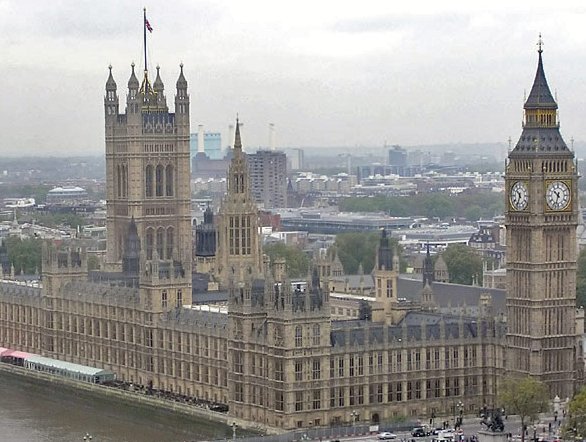
An alternative to the current process used in the United Kingdom and others with the Westminster system. This is using the UK as an example.

  • General election Thursday May 7, 2015
  • Parliament reconvenes on the second Monday after an election. This is 11 days after the election and for this election that is Monday May 18.
  • Monday morning swear in the new members of parliament.
  • Monday afternoon elect the Speaker.
  • Tuesday the Speaker ask the House of Commons to nominate individuals to be called upon to form a government. A nominee must have at least 5% of the membership of the House or 33 members endorsing them.
  • If there is more then four nominees then the four with the most endorsements are called upon to form a council-designate which is a government in waiting. If there are four or less all are called to form a council-designate.
  • Obviously before the UK Parliament meets there will be intensive negotiations behind the scenes to form a majority coalition if no party has the majority.
  • This is done Tuesday morning and later the Speaker of the Commons calls upon Her Majesty to invite the listed individuals to form council-designates.
  • Tuesday afternoon they are called in at 1, 2, 3, and 4 o’clock and are invited by the sovereign to form a governments-in-waiting to be called upon by Her Majesty to form the government should they have the confidence of the House of Commons.
  • Each nominee then forms a council-designate of say 16-24 members that would form the government should it have the confidence of the House.
  • Wednesday morning the Commons then votes on the question, “which of these councils-designate has the confidence of this House to form Her Majesty’s government in this Parliament ?
  • If no council gets a majority then a second vote is held with only the top two from the first vote on it. The council with the majority becomes the Council of Ministers and the runner up council becomes the Council of Opposition.
  • In 2005 the first vote would be something like Labour 411, Conservative 174, and Liberal Democrat 55. Labour forms the government, conservatives the opposition, and the Liberal Democrats an alternate council. After the last election the first and only vote would be something like Coalition (Tory/Lib-Dem) 415 and Labour 217. A coalition government and Labour as the opposition.
  • Parliament would have a fixed term and set election day. You can only have early elections by a motion of dissolution passing the Commons by 480 votes (75%).
  • There are no non-confidence motions. The government serves for the duration of that Parliament unless the Commons passes a motion of dismissal against the government and replaces it with another.
  • Any minister can be removed by a motion of dismissal passed by a 2/3 majority vote with quorum, including the PM.
  • The Council of Ministers can be replaced by a motion of government dismissal passed by an absolute 2/3 majority. This motion must have a nominee for Prime Minister who is called upon to form a new government if the motion of dismissal against the government gets the 434 votes. No member of the defeated government can be included in this new government.

Greater stability since the House of Commons establishes confidence in a government right at the start of a new Parliament and the government serves for the duration of that Parliament which has a fixed term and set election day. Only by super majorities can this be changed. An absolute 2/3 majority to replace the current government with a new one that then serves till the next election or an absolute 3/4 majority vote that actually does dissolve Parliament and triggers new elections. Note the scheduled general election still occurs so instead of having 1 full Parliament that lasts 4 years you have two short Parliaments that last a combined duration of 4 years. The second short Parliament can not be dissolved for early elections.

Acting president: Barry Aulis

Rebranding

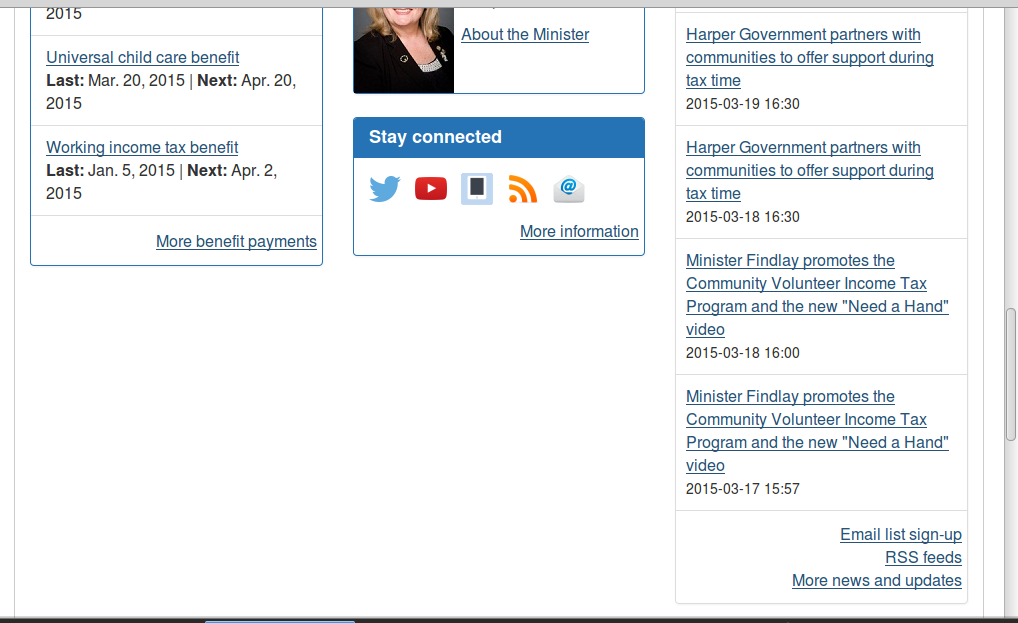
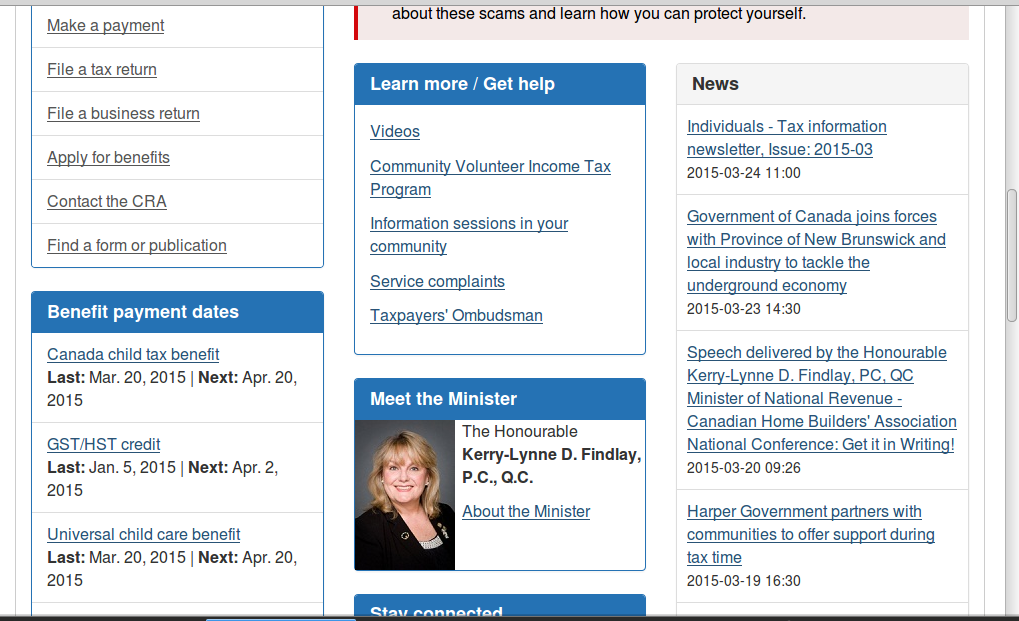
Re-branding the Government of Canada Stephen Harper style.

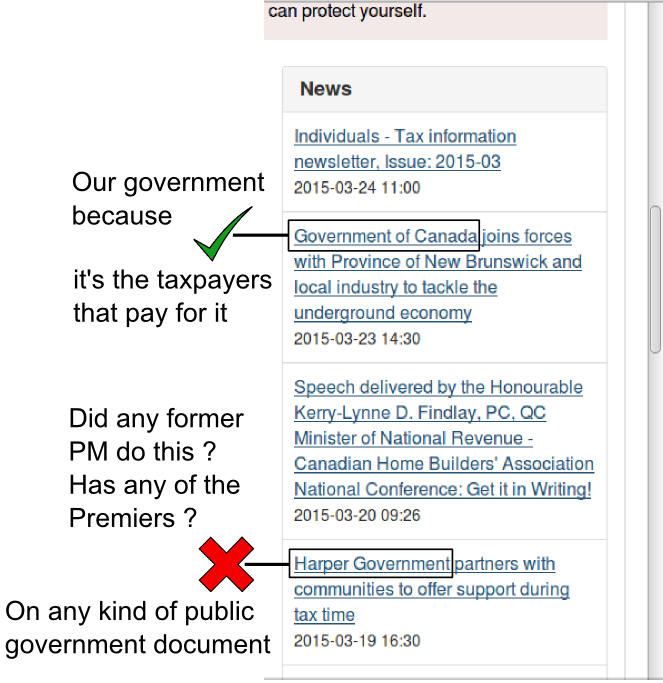
See anything wrong with the picture?

Screen1

How about this one?

These are screens shots from Revenue Canada’s home page. Taken March 25

Screen2

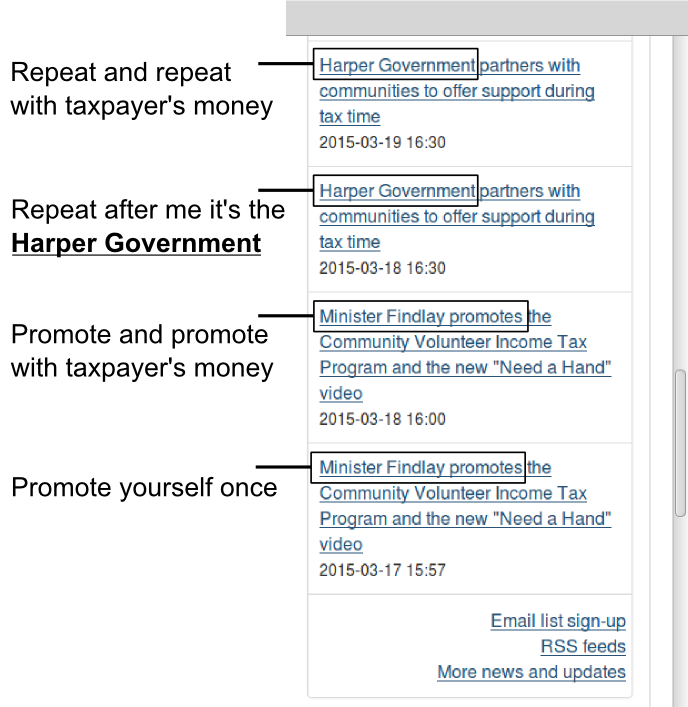
Close up of the right pane under news. I came across this before when doing my taxes in 2014. I copied the web address but didn’t take a screen shot. The address doesn’t go to any web page now.

g4114

Oldest at the bottom and newest at the top. Repeat after me it’s the Harper Government and not the Government of Canada.

g4543

Acting President: Barry Aulis

I remember the roll out of Canada’s New government phrase but didn’t know that afterwards they shifted to the “Harper Government”. To me this is illegal, he is not the owner and if the real owners don’t seem to care. What’s to be done? If a government you support can do this than a government you oppose can do it as well. Do you design the system fail safe or fail deadly?

Government formation

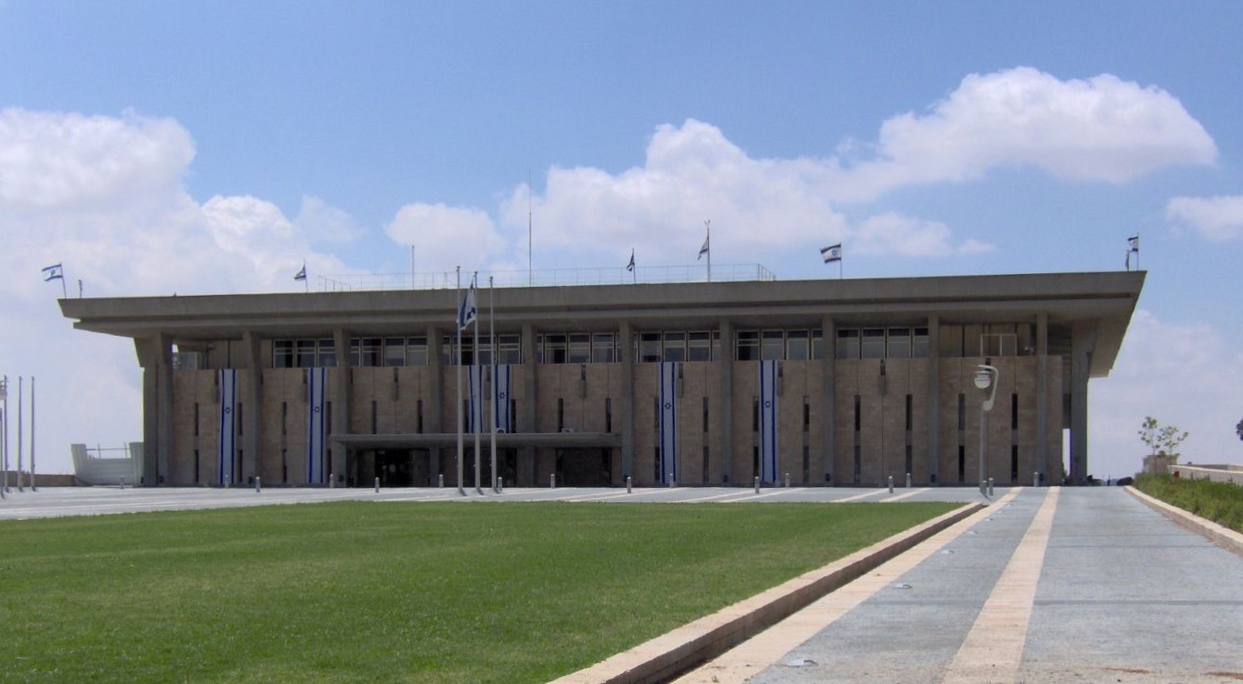
IM000791.JPGAn alternative to the current process used in Israel.


  • Swear in the new members of the Knesset.
  • Elect the Speaker.
  • The Speaker ask the Knesset to nominate individuals to be called upon to form a government. A nominee must have at least 6 members endorsing them (5%).
  • If there is more then four nominees then the four with the most endorsements are chosen.
  • Obviously before the Knesset meets there will be intensive negotiations behind the scenes to form a majority coalition.
  • Each nominee then forms a council-designate of say 14-20 members that would form the government should it have the confidence of the Knesset.
  • The Knesset then votes on the question, “which of these councils-designate has the confidence of the Knesset to form the government of Israel in this Knesset.
  • If no council gets a majority then a second vote is held with only the top two from the first vote on it.
  • The council with the majority becomes the Council of Ministers and the runner up council becomes the Council of Opposition.
  • The Knesset has a fixed term and set election day. You can only have early elections by a motion of dissolution passing the Knesset by 90 votes (75%).
  • There are no non confidence motions. The government serves for the duration of the Knesset unless the Knesset passes a motion of dissolution or a motion of dismissal against the government and replaces it with another.
  • Any minister can be removed by a motion of dismissal passed by a 2/3 majority vote with quorum, including the PM.
  • The Council of Ministers can be replaced by a motion of dismissal passed by an absolute 2/3 majority (80). This motion must have a nominee for Prime Minister who is called upon to form a new government if the motion of dismissal against the government gets the 80 votes. No member of the defeated government can be included in this new government.

Greater stability since the Knesset establishes confidence in a government right at the start of a new Knesset and the government serves for the duration of that Knesset which has a fixed term and election day. Only by super majorities can this be changed. An absolute 2/3 majority to replace the current government with a new one that then serves till the next election or a 3/4 majority vote that actually does dissolve the Knesset and triggers new elections.

Daylight saving hours

Read the title again, that’s right, instead of having daylight saving time have daylight saving hour. Instead of setting the clocks ahead one hour simply put the business and public office hours back one hour. My bank opens up at 10:00 AM on Friday but with daylight saving hours it opens up at 9:00 AM on Monday. My local IGA store will open up at 7AM and close at 10PM on Saturday and on Sunday with daylight saving hours it opens up at 6AM and closes at 9PM. Setting the clocks ahead just does the same effect.