Lonnng may she Reign

queennot

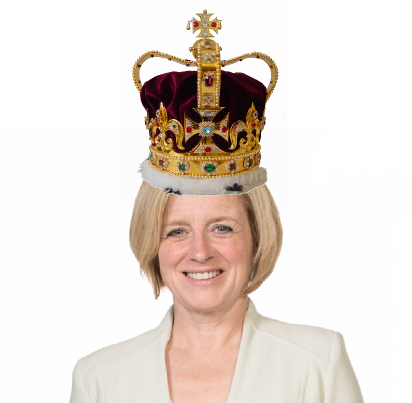
Another Political Monarch (PM) begins her reign. Deborah Drever expelled

“If she does so as part of her duties to her constituents, I’ll review this matter in the coming year and consider whether she has a future in our caucus.”        Queen Notley

Miss Imperial to the Non-Democratic Party hilt. In the Federalist party of Canada only the caucus can suspend or expell one of it’s members not the Party Leader. By secret ballot by an absolute 2/3 majority the caucus can suspend a member and by a 3/4 majority vote expell a member.

But are any of the other parties any better?

Alberta General Election 2015

o-ALBERTA-ELECTION-2015-facebookDual Electoral System

Voting is done by a preference ballot. On the first count of the ballots the top two candidates in each riding are elected. On the second count of the ballots the elected candidates get one vote for every ballot they have the lower number on. All the votes cast for the candidates who did not get elected are transferred to one of the top two candidates in that riding.

In the Legislature each member has one vote in regular session. In legislative session they have one vote for each of the votes they received on the second count of the ballots. The Legislature goes into legislative session every Thursday at 1 PM and during that session any bills up for a vote that week are voted on and passed or defeated. Any bills that were adopted by the Assembly are on the desk of the Lieutenant-Governor Friday morning for Royal assent.

Try it before you buy it. Form the Legislature advisory council. The members are the top two candidates from each riding. Each member has the one vote in regular session of the council. All of the candidates not on the council transfers their votes to one of the council members from their riding. All votes do get represented. These are voted when the council is in legislative session. Regular session votes advise the Assembly on procedural votes and in legislative session on votes to pass legislation.

Alberta General Election 2015

Party

Popular vote

Seats

Dual seats

Dual votes

NDP

41%

53 / 61%

71 / 41%

38% – 41%

PC

28%

10 / 11%

67 / 39%

41% – 44%

Wild Rose

24%

21 / 24%

33 / 19%

15% – 17%

Liberal

4%

1 / 1%

2 / 1%

1% – 2%

Alberta

2%

1 / 1%

1 / <1%

1%

Where the votes go on the second count of the ballots under the Dual Electoral System.

All the NDP vote goes to the PC candidate in the ridings where the top two are the PC and Wild Rose candidates. All the PC votes goes to Wild Rose where its the Wild Rose and the NDP. All the Wild Rose votes goes to the PC where the PC and NDP are the top two candidates. All the Liberal vote goes to the NDP

A clear majority votes for conservative parties but the Left-wing NDP gets 61% of the seats in the Legislature because of vote splitting. Wild Rose gets fewer votes then the PC but end up with more then double the seats. Time for a change. Time to try it before you buy it with the Dual Electoral System.

Under the Dual Electoral System the PCs would have ended up with a plurality of the votes in legislative session because of the transfer of votes from defeated Wild Rose candidates and some from the NDP in ridings where the top two candidates are the PC and Wild Rose. Together these conservative parties would have 56% – 60% of the votes in legislative session.

PEI General Election 2015

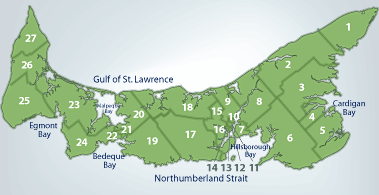
pei_mapAgain the disproportionate results produced by the first past the post system. A big majority votes against a Party yet they get a super majority of the seats and votes in the legislature. In the last PEI Provincial legislature I mailed, YES! the Canada post kind, all the MLAs with a letter detailing the Dual Electoral System. That system is again stated in a recent post on the Party blog of the Federalist party of Canada.

Voting is done by a preference ballot. On the first count of the ballots the top two candidates in each riding are elected. On the second count of the ballots the elected candidates get one vote for every ballot they have the lower number on. All the votes cast for the candidates who did not get elected are transferred to one of the top two candidates in that riding.

In the Legislature each member has one vote in regular session. In legislative session they have one vote for each of the votes they received on the second count of the ballots. The Legislature goes into legislative session every Thursday at 1 PM and during that session any bills up for a vote that week are voted on and passed or defeated. Any bills that were adopted by the Assembly are on the desk of the Lieutenant-Governor Friday morning for Royal assent.

In regular session in the last Legislature it would have been 50% Liberal and 50% PC. The operation of the Assembly is done on a non-partisan basis for no one party can gain a majority. In legislative session the Liberals would have had a solid majority and there is your proportional representation.

Try it before you buy it. Form the Legislature advisory council. The members are the top two candidates from each riding. Each member has the one vote in regular session of the council. All of the candidates not on the council transfers their votes to one of the council members from their riding. All votes do get represented. These are voted when the council is in legislative session. Regular session votes advise the Assembly on procedural votes and in legislative session on votes to pass legislation.

If PEI adopted the Dual Electoral System have 15 ridings for 30 members or 12 ridings for 24 members.

PEI Election 2015: What the Legislature advisory council would look like.

Party

Popular vote

Seats

Dual seats

Dual votes

Liberal

41%

18 / 67%

27 / 50%

42% – 62%

PC

37%

8 / 30%

26 / 48%

36% – 56%

NDP

11%

0 / 0%

0 / 0%

0%

Green

11%

1 / 4%

1 / 2%

2%

It is where the Green and NDP vote goes whether to the Liberal candidate or the PC candidate that would determine who gets a possible majority in the Assembly. If the Liberals get half they would have 52% of the legislative vote under the Dual Electoral System. Even if they got a 2/3 majority of these votes they would have 55% of the legislative vote.

59% vote against the Liberals and they get 67% of the seats. Time for a change. Time to try it before you buy it with the Dual Electoral System.

Politics of Confirmation

lorettalynchThe Senators of the US Congress finally did their job and voted to either confirm or reject the appointment of Loretta Lynch for the position of Attorney general. I remember the nomination of Judge Bork for the US Supreme court. I can remember thinking at that time the US Senate has every right to confirm, it has every right to reject, but the Senators have no right to avoid or delay making that decision to confirm or reject. They are being paid a salary to do a job. That job with any presidential appointment that requires senate confirmation is to come to a decision that the appointee is qualified or not to hold the position that they have been nominated for. Confirm it or reject it but 24 weeks of partisan Bull s**t is enough. Your job as a US Senator is to make the determination that Loretta Lynch is qualified or not to be the US Attorney general. Not to play pure partisan politics with it. Who do the Senators work for, the citizens and taxpayers of the US of A, or the vested interests and partisan donors of permanent campaign mode? God bless America caus’ I think she needs it!

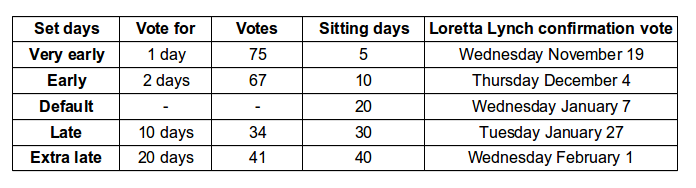
I came up with this idea 28 years ago when Judge Bork was nominated to be an associate Justice of the US Supreme court. Have 5 set days for when the confirmation vote is held. A default day of the 20th sitting of the Senate after the nomination. The Senate by super majority votes can hold the vote earlier at 5 or 10 sitting days after the nomination. The Senate by minority votes can hold the confirmation vote later then the default day at either 30 or 40 sitting days of the Senate after the nomination by the President. This is summed up below.

Untitled 1

Set days are the 5 days on which the Senate will vote to confirm.

Vote for is the sitting day after the nomination when the Senate votes to hold the confirmation vote for other then the default day. One day after the nomination is the vote to hold the confirmation vote very early, two days after is the vote for an early confirmation, ten days after is the vote for a late confirmation, and twenty days after is the vote for an extra late confirmation.

Votes is the votes required to change from the default day to that set day.

Sitting days is how many days when the Senate is in session after the nomination that the Senate holds the confirmation vote.

Attorney general Lynch was nominated by President Obama on Saturday November 8, 2014. The default set day for her confirmation vote would have been Wednesday January 7, 2015, 20 sitting days of the Senate or 8 weeks after her nomination. The earliest day for the confirmation vote would have been 11 days after and the last day would have been 3 months after her nomination and not this five and a half months crap.

Fixed date elections

jim-prenticeAll these fixed date election laws still mean the political monarch (PM) can have early elections or in a minority situation the opposition can trigger early elections. Ditch the Westminster system and have fixed date election on a set election day just the same as our municipal governments.

Separate out the vote for the executive in a confidence ballot which asks “Which of these councils-designate has your confidence to form the Council of Ministers in the next Parliament?” The leaders of the 4 parties with the most popular vote in the last election are called upon to form these councils-designate. Two ballots, one to elect the executive and one to elect the MP. Just like our municipal elections, a ballot to elect the mayor and a ballot to elect the municipal councillor.

Without electing the government have the House of Commons or Legislative Assembly elect the government right at the start of Parliament. After the members are swore in and the election of the Speaker put the question to the members “Which of these councils-designate has your confidence to form the Council of Ministers in this Parliament?” The four most endorsed nominees for PM are called upon to form these councils-designates. Winner forms the Council of Minsters and the runner up the Council of Opposition and they serve for the duration of that Parliament. No confidence motions and only a motion of governmental dismissal can bring down a government. This motion must name a nominee to become the new PM and the motion takes an absolute 2/3 majority to pass. No member in the preceding cabinet can be in the new one. Individual minsters including the PM can still be removed from office at any time by a motion of dismissal that requires a 2/3 majority vote with quorum.

A set election day of say the last Monday in October and fixed terms for the Parliament of Canada and the Provincial Legislatures. Federal elections to be in 2015 and every 4 years after and provincially 2017 and every 4 years after. All municipal elections are to be held only in even numbered years.