
Reform of the US presidential nomination process
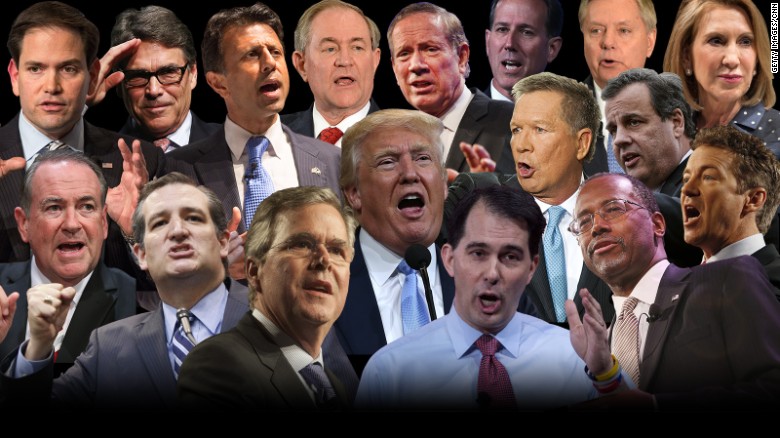
If anybody had to create the rules and procedure for nominating a Party’s candidate for President of the United States of America from scratch it would guaranteed not be the current system. Using the current group of candidates for the Republican nomination here’s my ideas to reform this process.
There would be 5 phases in the process.
- Pre-nomination phase
- Nomination phase
- Endorsement phase
- Campaign phase
- Voting phase
Pre-nomination phase
Any interested registered republicans who are eligible to run for president open up a campaign account (not candidate account) by paying a registration fee. This fee is based upon the first number of 1 significant figure equal or greater than the per capita GDP. This is $50,000 – $55,000 so that’s $60,000. The fee itself would be 10 times this figure or $600,000. It would take at least 10 registered republicans to pay the fee for the maximum contribution is the base amount of $60,000. The time to register would be from July 1 to July 31 2015 inclusive for the 2016 nomination.
There would be 5 set pre-nomination debates to be held at or hosted by the presidential libraries of the last 5 deceased republican presidents. In order they are Hoover-August, Eisenhower-September, Nixon-October, Ford-November, and Reagan-December. The debates would be in groups of no more then 5 candidates plus the moderator. With the 17 current candidates that gives you 4 groups, one of 5 candidates, and three of 4 candidates. Who’s on with whom is determined randomly. The debates are spread out over a week with one a night. In all subsequent debates the grouping of the candidates is determined by computer selection so that a candidate is in a group with other candidates they haven’t debated with before.
Nomination phase
Registration to be a candidate for the republican nomination goes from January 1 to 15, 2016 inclusive and the registration fee is 100 times the base amount so $6,000,000. This opens up a candidate account and it would take at least 100 registered republicans to pay the fee for the maximum contribution is the $60,000 base amount. One can declare one’s candidacy or get nominated by a group of republicans paying the fee. If a person is nominated they have till Noon EST January 31 to accept being nominated. The two incumbent candidates are the two candidates in the last contested nomination with the most votes. That would be Mr. Romney and Mr. Santorum. They would also have till January 31 to declare their candidacy, they do not have to pay the registration fee, and are automatically on the ballot for the nomination.
Endorsement phase
This phase would go from February 1 to March 15. It will determine who will be on the ballot NOT who will be the nominee. On the ballot will be the two incumbents plus the four candidates with the most endorsements, OR 1 incumbent with the five most endorsed candidates, OR with no incumbent running the six candidates with the most endorsements. Any registered republican can endorse a candidate including any incumbent with that endorsement being public and can’t be changed unless that candidate withdraws from the race in which case they can endorse a new candidate.
When republicans can start endorsing a candidate goes in stages. At midnight EST in Dixville notch township Hew Hampshire on February 1 republicans there become the first in the nation to endorse a candidate. At 6 AM EST those in the largest county in Iowa can start endorsing and at Noon EST those in the largest county in New Hampshire go next. Starting on February 2 and every day after you have the 50 states with 2 a day going in order of the state where the republican candidate in the last election had the highest percentage of the vote and the state where that candidate had the most number of votes. Each day the top state from each list can start endorsing a candidate. After all the states are done you have Washington DC and the 5 other territories then able to endorse.
For the Republicans in 2016 the order would be:
February 1 Dixville notch township and 2 largest counties in Iowa & New Hampshire
February 2 Utah / California
February 3 Wyoming / Texas
February 4 Oklahoma / Florida
February 5 Idaho / Pennsylvania
February 6 West Virginia / Ohio
February 7 Arkansas / New York
February 8 Alabama / North Carolina
February 9 Kentucky / Illinois
February 10 Nebraska / Michigan
February 11 Kansas / Georgia
February 12 Tennessee / Virginia
February 13 North Dakota / Missouri
February 14 South Dakota / New jersey
February 15 Louisiana / Indiana
February 16 Montana / Wisconsin
February 17 Mississippi / Minnesota
February 18 Alaska / Washington
February 19 South Carolina / Arizona
February 20 New Hampshire / Massachusetts
February 21 Iowa / Colorado
February 22 Nevada / Maryland
February 23 New Mexico / Oregon
February 24 Maine / Connecticut
February 25 Delaware / Rhode Island
February 26 Vermont / Hawaii
February 27 Washington DC & the 5 other territories
On March first the list is reduced to the 8 most endorsed candidates who is not an incumbent candidate. On March 7 down to the 7 most endorsed and on March 15 you will have a list of the 6 most endorsed candidates. If both the incumbents are running then they are on the ballot with the top 4 from the list, if only one then the top 5 on that list, and with no incumbent all on this final list are on the ballot for the vote for the republican nomination for president.
There will be 2 debates one between the 5th to 10th of February and one between the 15th and 20th of February. The candidates are divided into 3 groups determined by number of endorsements by the 5th of the month for the first debate and the 15th of the month for the second debate. The 6 most endorsed candidates are in the last group to debate, the 7th to 12th most endorsed candidates go before them, and all other candidates are in a third group that debates first. The debates are held on three consecutive nights.
Campaign phase
The campaign phase starts March 16 and goes to June 5 2016 the Sunday before the first Monday in June. There would be 4 set debates; the first week of April, the third week of April, the first week of May, and the last in the third week of May. All candidates take part.
Voting phase
Voting would start on the first Monday of June and the last day to vote would be the last Friday in June. For 2016 this would be June 6th to June 24th. A candidate is elected by direct popular vote of the registered members of the republican party. The ballot would be a preference ballot where you rank the 6 candidates in order of choice, your first choice to win the nomination, your second choice, your third, fourth, and fifth.
Convention
The result is already known but not made available to the candidates or the public till the Conventions. The party who lost the election last time their Convention is held between July 15th to July 31st. The winning party last time has their convention from August 1st to August 15th. At each Convention there would be 2 screens on stage one showing the results from a state or territory and the other the total votes received for each candidate. The candidate with the most votes is marked as Leading if they have a plurality of the votes, or as Elect if they have a majority of the votes, or as the Winner when any further state or territory vote’s can not make them lose their majority of the ballots.
The results are revealed one by one for each state and territory at 30 second intervals so it will take 28 minutes to go through one count of the ballots. If no candidate was declared the winner then the next count of the ballots is revealed with the candidate with the least votes dropped and their votes going to a remaining candidate by the order in which the voters ranked them. It might take 5 counts of the ballots to have a winner or over 2 hours after the results were started to be revealed. The order in which a state or territory is displayed is based upon the percentage of the vote for the Party’s candidate in the last election. The lowest percentage going first and the highest percentage last. For the Republicans it would be Washington DC first and the state of Utah last.

 Seven more days till the 42nd Federal general election. All citizens should vote and view doing so as an obligation to their fellow citizens. I missed the first federal election I was eligible to vote in and I can’t recall why I didn’t. The same for Quebec but I wasn’t in the province at the time. But I’m 8 for 8 of the last general elections for both the Federal and Quebec. Voted for the first time by advanced poll. It opened up at noon on Friday October 12 and I was down there at 1:30. A line up which I didn’t expect. Maybe around 20-40 people ahead of me. I didn’t get out till 2:30 so an hour to vote. The only difference from regular being required to sign a register. I was surprised to see the Rhino party on the ballot.
 The Federalist party of Canada