
Federalist Party
Meta
Archives
- May 2025
- April 2025
- March 2025
- July 2024
- May 2021
- October 2019
- April 2019
- January 2019
- December 2018
- October 2018
- August 2018
- January 2018
- March 2017
- February 2017
- January 2017
- November 2016
- October 2016
- June 2016
- May 2016
- April 2016
- March 2016
- February 2016
- January 2016
- November 2015
- October 2015
- September 2015
- August 2015
- July 2015
- May 2015
- April 2015
- March 2015
- January 2015
- December 2014
- November 2014
- September 2014
- August 2014
- July 2014
- June 2014
- April 2014
- March 2014
- January 2014
- December 2013
- November 2013
- October 2013
- September 2013
- June 2013
- March 2013
- December 2012
- November 2012
- October 2012
- September 2012
- August 2012
- October 2011
- September 2011
Categories
Electoral Map
 I advocate the adoption of the Dual Electoral System with the number of seats set at 150. This giving a House of Commons of 300 members. After each election the percentage of eligible voters out of the national total is determined for each province and territory. This is used to determine the number of seats to be allotted to 2 decimal places. The decimal remainder is dropped giving you less the 150 seats. Any province or territory that has 0 seats is given 1 seat. All provinces and territories are guaranteed at least 1 seat. If the number of seats is still less then 150 then additional seats are allotted to a province or territory in order of the highest remainder first till 150 is reached.
|
Province / Territory |
Eligible voters |
150 seats |
Additional |
Seats / MPs |
|
British Columbia |
3,340,830 |
19.55 |
19 / 38 |
|
|
Alberta |
2,791,346 |
16.33 |
16 / 32 |
|
|
Saskatchewan |
765,102 |
4.48 |
4 / 8 |
|
|
Manitoba |
873,492 |
5.11 |
5 / 10 |
|
|
Ontario |
9,560,745 |
55.94 |
+1** |
56 / 112 |
|
Quebec |
6,373,482 |
37.29 |
37 / 74 |
|
|
New Brunswick |
592,925 |
3.47 |
3 / 6 |
|
|
Nova Scotia |
736,008 |
4.31 |
4 / 8 |
|
|
PEI |
112,975 |
0.66 |
+1* |
1 / 2 |
|
Newfoundland |
416,536 |
2.44 |
2 / 4 |
|
|
Yukon |
26,283 |
0.15 |
+1* |
1 / 2 |
|
NWT |
29,432 |
0.17 |
+1* |
1 / 2 |
|
Nunavut |
19,223 |
0.11 |
+1* |
1 / 2 |
|
Total |
25,638,379 |
145 |
+5 |
150 / 300 |
*Additional to have at least 1 seat
**Additional to bring seat total to 150.
Instead of a full revision of the electoral map every 10 years you have a partial revision after each election. The smallest riding in a province or territory must be at least 50% of the number of voters of the largest riding in that jurisdiction. Because you can have the ridings with a greater spread in number of voters you don’t have to have ridings within a narrow range. A province or territory that gains or loses seats will have some boundaries redrawn. A jurisdiction that doesn’t change in the number of seats might have some ridings redrawn to keep ridings within the range of 50% of the largest in that province or territory.
42nd Federal Election
Dual Electoral System
https://federalistpartycanada.wordpress.com/2012/09/15/letters-to-pei/
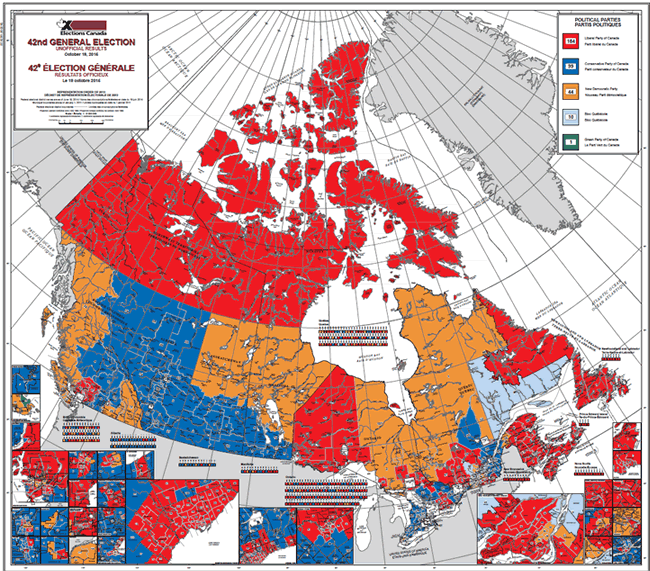
Results 42nd Federal election October 19, 2015
Finished converting the results riding by riding from the election. I advocate a 300 member House of Commons elected from 150 ridings. If that was the case the election would have result in roughly 134 Liberals, 99 Conservative, 57 NDP, 9 Bloc, and 1 Green Members of Parliament.
Seats under current and dual electoral system
|
Seats |
Liberal |
Cons |
NDP |
Bloc |
Green |
Ind |
Total |
|
Current |
184 |
99 |
44 |
10 |
1 |
0 |
338 |
|
Dual |
301 |
223 |
128 |
21 |
2 |
1* |
676 |
*Scott Andrews in Avalon (Newfoundland and labrador)
Votes in the House and legislative votes uder dual electoral system
|
Votes % |
Liberal |
Cons |
NDP |
Bloc |
Green |
Ind |
|
Current |
54% |
29% |
13% |
3% |
0.3% |
0% |
|
Votes #* |
8,755 |
4,958 |
3,031 |
480 |
80 |
13 |
|
Dual |
51% |
29% |
18% |
3% |
0.5% |
0.1% |
*In thousands of votes
With Liberal/Cons elected NDP & Bloc & Green go to the Liberals
Liberal/NDP elected Bloc & Green to NDP , Cons 2/3 to Liberals
Cons/NDP elected Liberal & Bloc & Green to the NDP
Liberal/Bloc elected NDP & Green & Cons 1/2 to each
NDP/Bloc elected Liberal & Green to NDP , Cons 1/2 to each
Election day
 Election day for the 42nd federal general election.
Time for all those eligible to vote and who haven’t already done so to vote.
I voted by advanced poll on Friday October 9.
It has been said that democracy is the worst form of government except all the others that have been tried. Winston Churchill
Custom and Precedence
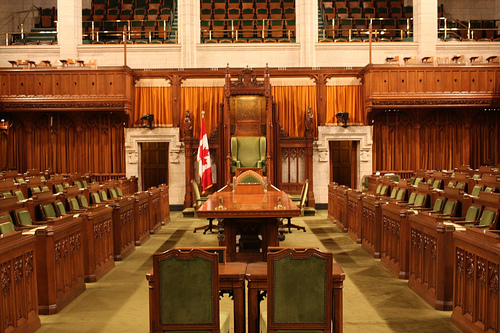 At the start of each Parliament the Speaker after the members of the House of Commons are sworn in asks “who should the Governor-General call upon to form a government”? The four most endorsed candidates are invited to Rideau Hall and asked to form a council-designate, a government-in-waiting. After each leader who accepts forms a proposed government of say 16 to 20 members the Speaker puts the question to the House “which of these councils-designate has the confidence of this House”? The two with the least are dropped from the second ballot. The Commons votes a second time with the winner becoming the Council of Ministers and the loser the Council of Opposition. No vote in the House triggers an election only an absolute 2/3 majority (226 out of 338) passing a motion of dissolution can trigger an election before the set election day. No vote can replace the current government with another. The Council of Ministers is the government for the duration of that Parliament. Any individual minister can be dismissed by a 60% vote of the House. If it’s the Prime Minister then an absolute 60% majority (203).
Posted in Event, Founder, News
Tagged government formation, Government reform, miniority government, westminster system
 The Federalist party of Canada