Category Archives: policy

Committee


Long ago I delt with this issue and came up with 18 Common’s committees each having 20 seats for 360 committee assignments in total. They are awarded in proportion to each Party’s seats in the House of Commons with Independents treated as a bloc like a Party.
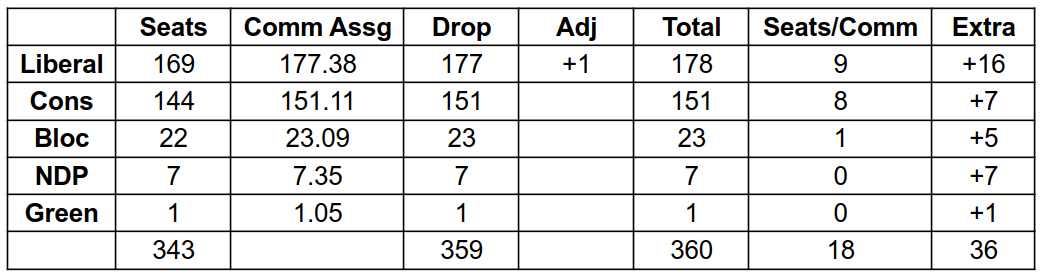
Seats is the number of seats held in the House of Commons.

Comm assg is the number of committee assignments out of (Seats/343) X 360.

Drop is drop the decimal remainder.

Adj is awarding one extra assignment in order of highest decimal remainder till you get the 360 total committee seats.

Total is the total number of committee seats a Party is assigned.

Seats/Comm is the number of seats they have on every committee.

Extra is the seats left over which is 36 assignments or 2 seats per committee.

The extra seats are chosen by the House Leaders in order of largest to smallest so, Liberal, Conservative, Bloc, NDP, and then Mrs. Elizabeth May.

The first round each House Leader chooses 1 committee seat for their Party then Mrs. May chooses hers. This process goes round after round until all 360 committee seats have been assigned.

Independents are treated as a Party for the determination of the number of committee assignments but are chosen by the Independent MPs in order of seniority. Each round when the Independents choose, the most senior MP who hasn’t chosen a committee assignment selects one that’s open.

All MPs get to sit on at least 1 committee with some getting 2 assignments.
Percentage


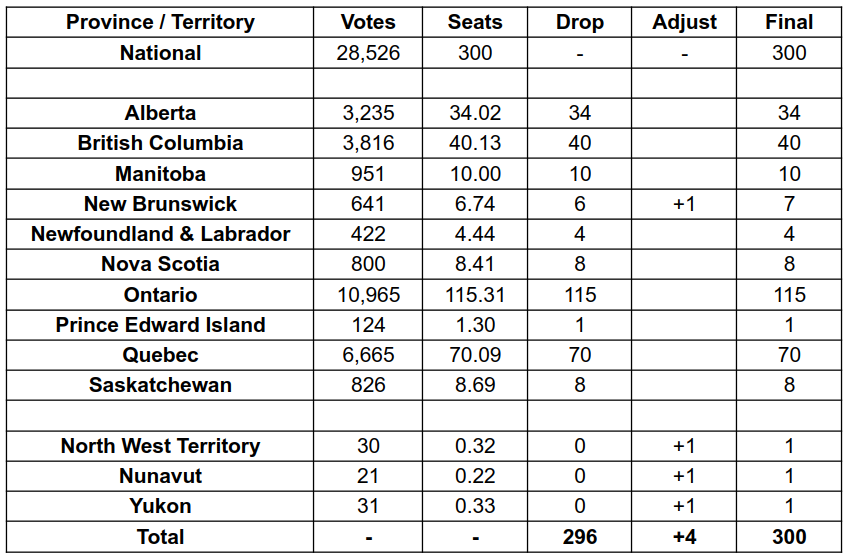
If you have X% of the eligible voters you will have X% of the seats. Modified to guaranty that every region has one seat.

Votes are the number of eligible voters in the last election expressed in the thousands.

Seats are the number of seats to 2 decimal places.

Drop is dropping the decimal remainder leaving you with 296 seats.

Adjust is the adjustment of adding 4 seats to bring the total to 300. The 3 Territories each get 1 since every province or territory is guarantied at least 1 seat. The remaining 1 seat adjustment goes to New Brunswick since it is the one with the highest decimal remainder.

Final is the seat count after the adjustment.

Official Party (UK version)


Out of curiosity, if the UK adopted the Official Party rule which Parties would have official status? These are all the Parties that got at least 1% of the vote in the last 3 elections. Votes are in the millions and is the total of the votes received in the last 3 general elections in 2017, 2019, and 2024.

In all of the last 3 general elections the Conservatives, Labour, and the Liberal Democrats got 5% of the vote. The Green Party only got 5% in the last election. UKIP/Reform got 5% in the last election, also in 2015, but not in the 2 elections in between.

Prior to the 2024 election the UK would have had 4 Official Parties; Conservative, Labour, Liberal Democrat, and UKIP. After this last election the Green party would have official status as well bringing the total up to 5 Official Parties.

Non voting members

All Leaders of Official Parties should be given a non-voting seat in the House of Commons. Check the post below and Canada has 5 Official Parties; Liberal, Conservative, NDP, Bloc, and the Green Party. Poilievre will not have to ask someone to step aside and trigger an unnecessary by-election and the new Leader of the NDP, when elected, will get to be in the House should they not be an MP.

Non-voting members do not vote, do not sit on any subsidiary body of the Commons, but can motion and speak in the House. US House of Representative’s non-voting members do sit on and vote in committee. These Territorial delegates do not vote on the House floor.

US Political Parties Part 3

Dual Electoral System

See earlier posts and have the House of Representatives form the House advisory council and the Senate create the Senate advisory council. As always try it before you buy it!

An alternative to the top 2 in an election being elected is have the top 2 with the third or fourth placed candidates also elected but only if they got 5% of the vote or more. The candidates not elected then transfer their votes to one of the 2, 3, or 4 candidates who did get elected.

Party name and colour

In order of attaining registered party status the Party chooses a colour and a name that’s different from any current federal party. The initial Parties would go in this order.

The Democratic Party: Chooses some colour of blue and no further Party can have the word democratic in it’s name

The Republican Party: Chooses some colour of red and no further Party can have the word republican in it’s name. There would be a question about the word republic.

The Progressive Party: Chooses some colour of green (Vermont the green mountain state) and no further Party can have progressive in it’s name. Again a question about progress or variants.

The Tea Party: Chooses some colour that tea comes in (hopefully Sarah Palin likes tea) and no further Party can have tea in it’s name.

The Trump Party: The Donald chooses his favorite colour and no further Party can have Trump in it’s name.