
Category Archives: News

Michael Chong vs Federalist Party

Coke-vs-Pepsi5Michael Chong’s Bill  vs  Federalist constitution

Bill C-559

National constitution

MC  65.1 Nomination contests shall be held by the registered association for the electoral district to which the nomination relates at a time and date fixed by the association and in accordance with the rules established by the association.

FP  10.2 The National Assembly and the National Congress in regular session by two-thirds majority votes shall pass a Federal Election bylaw to govern all national and nomination elections of the Party.

MC  (c) if applicable, an instrument in writing, signed by the nomination officer of the political party’s electoral district association for the electoral district that states that the prospective candidate is endorsed by the party.

FP  11.3 The Leader shall sign all nomination and Election Canada papers. Any refusal shall mean the automatic and immediate expulsion from the Party.

MC  A prospective candidate for a political party in an electoral district must be endorsed by the nomination officer of the party’s electoral district association of the party in that electoral district.

FP  10.5 There shall be a Federal Election Officer (FEO). This officer shall be responsible for the conduct of all national and nomination elections and the administration of the Party’s registered voters list.

MC  (2) The nomination officer referred to in subsection (1) shall be appointed by the members of the electoral district association by a majority vote.

FP  10.6 The Federal Election Officer is elected by a two-thirds majority vote of the National Congress in regular session with a concurring two-thirds majority vote of the National Assembly. This officer can be removed by the same vote in the Assembly and Congress. The term of office shall be for 10 years.

MC  (i) a leadership review may be initiated by the submission of a written notice to the caucus chair signed by at least 15% of the members of the party’s caucus,
(ii) a leadership review is to be conducted by secret ballot, with the result to be determined by a majority vote of the caucus members present at a meeting of the caucus, and
(iii) if a majority of caucus members present at the meeting referred to in subparagraph (ii) vote to replace the leader of the party, a second vote of the caucus shall be conducted immediately by secret ballot to appoint a person to serve as the interim leader of the party until a new leader has been duly elected by the party.

FP  5.8 By a majority vote in the National Assembly and an absolute majority in the National Congress in regular session any member may be suspended or dismissed from the Federal Council. This can also dismiss or suspend the Leader or Deputy leader.

MC  49.2 A member of a caucus may only be expelled from it if
(a) the caucus chair has received a written notice signed by at least 15% of the members of the caucus requesting that the member’s membership be reviewed at a meeting of the caucus; and
(b) the expulsion of the member is approved by a majority vote by secret ballot of the caucus members present at that meeting.

49.4 (1) After every general election or following the death, incapacity, resignation or removal of the chair of a caucus in accordance with subsection (2), a chair shall be elected by a majority vote by secret ballot of the members of that caucus who are present at a meeting of the caucus.

(b) the removal of the chair is approved by a majority vote by secret ballot of the caucus members present at that meeting.

FP  11.4 The House caucus shall consist of all Party members who are members of the House of Commons. The caucus by an absolute two-thirds majority vote can suspend an MP from caucus. The Senate caucus shall be the same as the House caucus with the two making the Parliament caucus.
11.5 The House leader shall be elected by a secret vote of the House caucus. The runner-up in such a vote becomes deputy House leader. These two officers are members of the Federal Council. The Party caucus in the Senate shall do the same.
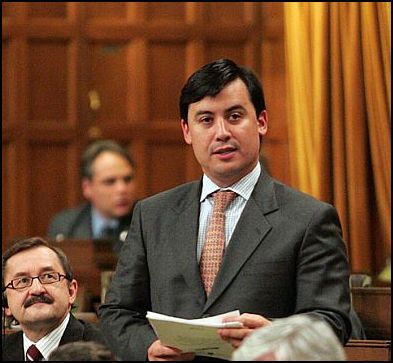

Michael Chong

Michael Chong MPMichael Chong MP for Wellington—Halton Hills has introduced a private members bill story here.

If you wont to change our politics you must first change the political parties.

I sent Mr. Chong the following email.

I read with interest about your private members bill it mirrors what has been done in the provisional constitution of the Federalist party of Canada.
The National Assembly is the members of the party who’ve registered to vote in the Assembly. The National congress is the candidates for the House of Commons. I think you might be interested in the following articles from the constitution.

5.8 By a majority vote in the National Assembly and an absolute majority in the National Congress in regular session any member may be suspended or dismissed from the Federal Council. This can also dismiss or suspend the Leader or Deputy leader.

11.3 The Leader shall sign all nomination and Election Canada papers. Any refusal shall mean the automatic and immediate expulsion from the Party.

11.4 The House caucus shall consist of all Party members who are members of the House of Commons. The caucus by an absolute two-thirds majority vote can suspend an MP from caucus. The Senate caucus shall be the same as the House caucus with the two making the Parliament caucus.

11.5 The House leader shall be elected by a secret vote of the House caucus. The runner-up in such a vote becomes deputy House leader. These two officers are members of the Federal Council. The Party caucus in the Senate shall do the same.

12.3 Key resolutions need two third majorities to be passed in the National Assembly, National Congress, and the Federal council. Key resolutions are motioned in the National policy committee. These resolutions form the National Party Platform and are binding upon a Federalist government and all Federalist MPs. Each Federalist MP can vote as they choose in the House of Commons. They may vote against a key resolution without penalty a number of times in each Parliament equal to the number of times they have been elected to the Commons.

Thanks Barry.

And nothing changes

45adc339c8799cb8b5104bade9230c6aAs you find from the table in three of the four by-elections the winning candidate won by a plurality and only one got a majority. Combined the winning candidates got less then 50% of the votes cast. With the Dual Electoral System the top two get elected and the votes cast for all others will go to one of these two elected candidates. In the by-elections the top two candidates got 85% of the votes cast so those voters get represented by their first choice and the other 15% of the vote will go to one of these so those voters get represented in Parliament by a secondary choice for MP.

Elected

Top two

Others

Bourassa

48%

79%

21%

Brandon-souris

44%

87%

13%

Provencher

58%

88%

12%

Toronto-centre

49%

85%

15%

All four ridings

49%

85%

15%

The Nuclear Option

nuclear-bomb-explosion

The nuclear option / CNN

I remember the nomination of Judge Bork to the Supreme Court by Pres. Ronald Reagan in the 80s. The nomination was opposed by the Democratic majority in the Senate and was rejected by the Senate. During this process I remember thinking that the Senate has every right to confirm the appointment, every right to reject the appointment, but no right to delay or abstain from making a decision on the appointment. With the Senate rule requiring 60 votes to end a filibuster this gives the minority the ability to block a decision made by a majority of the Senate. The majority has every right to pass a motion and every right to reject a motion but the minority has no right to prevent the majority from doing one or the other.

In the Senate rules dealing with nominations there should be five set days on which the Senate shall vote to confirm or reject any nomination.

  • The default day shall be the first daily sitting of the Senate that is 30 days after the nomination by the president.
  • By the vote of 67 senators the nomination vote will be the first daily sitting of the Senate that is 10 days after the nomination.
  • By a vote of 60 senators the nomination vote will be the first daily sitting of the Senate 20 days after the nomination.
  • By a vote of 34 senators the nomination will be voted on the first daily sitting of the Senate 45 days after the nomination.
  • By a vote of 50 senators the nomination will be voted on the first daily sitting of the Senate 60 days after the nomination.

This process gives you a default vote on a nomination 30 days after the appointment. By super majorities the Senate can vote earlier than the 30 days and by minorities can hold the vote later than those 30 days. The Senate shall hold a confirmation vote on a nomination on one of five set days they being 10 days, 20 days, 30 days, 45 days, and 60 days after the appointment by the president. If you wish to keep needing 60 votes to get to a vote on a nomination then have the rules state you need 60 votes to confirm not a simple majority.

The power of Democracy is vested in the majority and in the minority it’s principle

From the National Congress webpage.

Acting president  Barry Aulis

Disciplinary motion

rob-fordShould municipal councils have the authority to suspend or remove from office any municipal official? Yes!  From least to severest a municipal council should be able to impose the following penalties on those who hold a public office in that municipality.

  • A motion of reprimand which is the proverbial slap on the wrist but an official one done by an absolute majority on the council which for the Toronto city council is 23 out of the 44 councillors.
  • A motion of censure that imposes a fine with the defendant losing their salary until the amount equals or exceeds the fine. This is to be done by an absolute 60% majority that for Toronto is 27 votes on the city council.
  • A motion of suspension that of course suspends an official from office for a temporary period with or without pay for that period of time. This motion is to be passed by an absolute two-thirds majority for Toronto that’s 30 votes.
  • A motion of dismissal that shall remove the defendant from office and this is to be passed by an absolute three quarters majority that for Toronto’s city council is 33 votes.

Of course Toronto’s city Councillors can be subjected to a disciplinary motion as well. A Councillor can’t vote on their own motion leaving you with 43 members voting. All motions requiring one less vote to pass except a motion of dismissal.