Category Archives: Founder

New Brunswick Election

1024px-Flag_of_New_Brunswick.svgThe Dual Electoral System is inspired from the House of Commons where you have a Leader representing the majority of the House and a Leader representing the largest minority of the House. Voting is conducted by a secret preference ballot where the voters mark the candidates in order of choice (1, 2, 3, 4, etc). The ballots are counted with the two candidates with the most votes getting elected. The ballots are counted a second time where the elected candidate with the lower number gets one Legislative vote for every vote received on the second count. In regular session each member has one vote which for the last New Brunswick General election would give both the PC and Liberals one vote less then 50%. The Legislature would operate on a consensual basis because no party can get a majority in regular session. The legislature would have a legislative session once a week where any bills requiring approval are voted on. Each member would have votes equal to their popular vote in their riding. All votes do count in an election for one of the elected candidates from your riding will receive your vote and cast it in Legislative session to determine the passage of legislation.
nb1

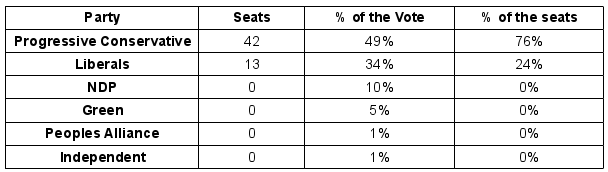
As the first table shows in the last General Election in New Brunswick ended with the PCs getting 76% of the seats though a majority of the voters voted against the conservatives. Also 17% of the voters voted for parties that gained no seat and so all those voters have no representation of any kind in the Legislature. The phrase “Taxation without Representation” comes to mind.
nb2

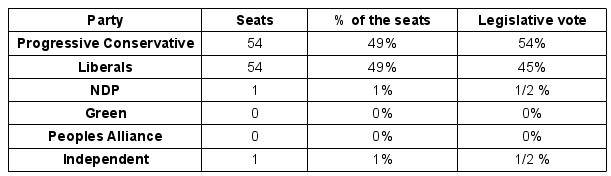
The second table shows the results using the Dual Electoral System. The top two candidates in each riding are elected. This gives both the Conservatives and Liberals the same number of seats and one seat shy of 50%. In regular session its one member one vote so no party rules the Legislature. In the riding of Woodstock the top two candidates were the PC candidate and an Independent Mr David Allen. In the riding of Tracadia-Shelia the top two candidates were the candidates for the Liberals and the NDP. In all other riding’s the top two candidates belonged to the PC and Liberals.

In Legislative session for the riding’s that elected the PC and Liberal candidates I made the assumption that 2/3 of the remaining vote would go Liberal and 1/3 to the PC. For the riding of Woodstock I decided all the secondary vote goes to the Independent candidate Mr David Allen. For the riding of Tracadia-Shelia I awarded all the votes for the PC to the Liberals and none to the NDP. The Legislative vote that the PC and Liberal parties would have better reflects the way the voters voted; PC 54% Leg / 49% Pop, Liberal 45% Leg / 34% Pop. Also all the votes cast for the other candidates just doesn’t disappear they go somewhere. If your vote doesn’t go to your first choice it goes to a secondary choice who in effect proxy votes it in the Legislative session of the New Brunswick Legislature. All votes do count!

If the Dual Electoral System were ever used create 25 provincial ridings with the smallest having at least 50% of the number of electors as the largest riding. This gives you a Legislature of 50 members from 25 dual member ridings. Each member having a number of votes in Legislative session equal to the votes received on the second count of the ballots. You mark your preference for all candidates and one of them will be voting your vote in the New Brunswick Legislature.

The New Brunswick Legislature should first create the Legislative Council consisting of the top two candidates in every riding giving you 98 members. In regular session of the Council its one member one vote. In each riding all the other candidates transfer their popular vote to one of the elected candidates for that riding. This is added to their own popular vote and the total is the number of votes they have when the Council is in Legislative session. The Legislative Council advises the Legislature by regular session on all motions before it. When the Legislature votes to pass a bill the Council advises it by voting in Legislative session. The 49 runner up candidates for each riding don’t get paid. With the operation of this advisory council one would get to see how the Legislature would work under the Dual Electoral System . In other words you can “try it before you buy it”!
Senate Appointments

1024px-Flag_of_the_Governor-General_of_Canada.svgOld method by the Political Monarch (PM)

The Governor-General of Canada shall by custom and NEW precedence make appointments to the Senate of Canada upon the advice of the Senate Appointment Council. This council is the top two candidates in each riding in the last Federal or By-election for every riding.

Cons    NDP    Lib    Bloc    Green    Ind    Total                                     226      219     114       46          4           7        616                                        37%     36%     19%    7%       0.6%     1.1 %

In PEI the top 2 provincial candidates would be 50% Lib and 50% Cons. In Alberta Cons 49% / Wild Rose 42% / Liberal 5% / NDP 4%.

When a seat becomes vacant a qualified candidate is nominated by any two members from the same riding. All nominees are put to a Yes or No vote by secret ballot of the Appointment council. To be recommended for appointment takes a 2/3 majority vote of the council. If there is more then one candidate then the one with the most votes is the one appointed.

All Senators can not be members or contributors to political parties. The Senate should be able to send a bill back to the House of Commons with amendments by a majority vote. Then send it back a second time with objections by a 2/3 majority vote and if passed by the House of Commons a third time the Senate is to pass it and give it to the Governor-General for Royal Assent. Only the ability to delay, recommend, and object.

The composition of the Senate should be changed. Give 3 seats to all provinces plus the Natives and 1 seat to each territory. This gives you 36 seats from 12 “regions”. Distribute another 36 seats among these 12 regions on the basis of population. Half of the 72 Senate members is determined by population and the other half by equal regional representation. The result is Ontario 16 / Quebec 11 / BC 8 / Alberta 7 / PEI 3 / Each territory 1 / and all others NS, NB, SK, Man, Nfld, Natives will have 4 seats each.

Fixed date elections

Image With the recent election in Quebec and the new one in Ontario we should should have fixed date elections like our municipalities and do away with elections called by the political monarch (PM or Premier) or by confidence votes. Have federal and provincial elections every 4 years. A federal election in 2015 and every 4 years after and provincial elections in 2017 and every 4 years after. Municipal elections to be held only in even numbered years. A set election date of the last Monday in October.

Election

Last

Term

Next

Term

Fixed

Federal

May 2011

4 1/2

Oct 2015

4

2019 +4

BC

June 2013

>

>

4 1/2

2017 +4

Alberta

April 2012

2 1/2

Oct 2014

3

2017 +4

Sask

Nov 2011

3

Oct 2014

3

2017 +4

Man

Oct 2011

3

Oct 2014

3

2017 +4

Ont

June 2014

>

>

3 1/3

2017 +4

Que

April 2014

>

>

3 1/2

2017 +4

NB

Sept 2010

4

Oct 2014

3

2017 +4

NS

Oct 2013

>

>

4

2017 +4

PEI

Oct 2011

3

Oct 2014

3

2017 +4

Nfld

Oct 2011

3

Oct 2014

3

2017 +4

Yukon

Oct 2011

3

Oct 2014

3

2017 +4

NWT

Oct 2011

3

Oct 2014

3

2017 +4

Nunavut

Oct 2013

>

>

4

2017 +4

At the start of each parliament hold a government election. A Leader forms a council-designate with the 4 most endorsed going to a vote. The third and fourth placed councils sworn in as executive councils. The top two going to a second vote. The winner becoming the council of ministers and the runner up the council of opposition for the duration of that parliament. No confidence motions. A motion of dismissal passed by a 2/3 majority can remove any minister from office. An absolute 2/3 majority can remove the Prime minister (206 / 308 next 226 / 338) or Premier (Quebec 84 / 125).

Quebec election 2014


Party

Liberal

PQ

CAQ

QS

Other

Vote

42%

25%

23%

8%

2%

Seats

70

30

22

3

0

Dual seats

100

88

54

7

1 (ind)

Leg vote

45%

30%

22%

3%

<1%


Vote is the percentage of the popular vote each party received. Seats is members elected by our first past the post system. Dual seats is members elected under the Dual Electoral System which elects the top two candidates in each riding so is 250 members for the National Assembly’s 125 seats. Each member has 1 vote in legislative session of the National Assembly for each vote received in the election. By either a run off election or a preference ballot voters cast a vote for one of the two elected candidates so the votes cast for the defeated candidates will get transferred to one of the two elected candidates.

The legislative vote is calculated from all the votes received by the top two candidates in each riding and deciding where the defeated candidates votes will go. The Liberals had 5% popular vote to be transferred. I decided to award 75% to the CAQ and 25% to the PQ. The PQ had 4% to be transferred so I put it 75% CAQ and 25% QS. The CAQ had 9% to be transferred I gave 67% to the Liberals and 33% to the PQ. QS had 6% to be transferred I awarded 67% to the PQ and the remainder split between the Liberals and CAQ. Th remaining 2% I gave equally to the Liberals and PQ. This gives you a rough idea of the distribution of votes and yes I went through the results riding by riding.

If Quebec ever adopted the Dual Electoral System I would suggest a National Assembly of 100 members being the top two candidates elected from 50 ridings. The smallest riding having 50% or more of the eligible voters compared to the largest riding.


Dumb, dumber, and just plain stupid

dunce

The answer is…..

Justin Trudeau, Stephen Harper, and the members of the Liberal and Conservative parties.

Conservative nomination story

Liberal nomination story

Both the Conservatives and Liberals are having trouble over their nominations. I quit the NDP in 2009 because as a riding president I received an email from the national office stating that to run in an nomination election you first had to be approved by the national office. I was an activist member for 7 years at that point and simply left the party. I had no say in this policy that just appears out of the blue. I founded a new federal party to operate differently then this.

13.0 Amendments to the Constitution of the Federalist Party of Canada shall be voted on and passed solely by the National Assembly of the Party.

The registered members of the federalist party vote directly by internet ballot on the party’s constitution. I personally would support adding the option of a mail-in ballot for members.

10.2 The National Assembly and the National Congress in regular session by two-thirds majority votes shall pass a Federal Election by-law to govern all national and nomination elections of the Party.

The rules that govern nomination elections must be passed by the National Assembly.

10.5 There shall be a Federal Election Officer (FEO). This officer shall be
responsible for the conduct of all national and nomination elections and the
administration of the Party’s voters list.

10.6 The Federal Election Officer is elected by a two-thirds majority vote of the National Congress in regular session with a concurring two-thirds majority vote of the National Assembly. This officer can be removed by the same vote in the Assembly and Congress. The term of office shall be for 10 years.

An independent non partisan election officer with a long term of office. The federalist party’s equivalent to the chief electoral officer.

4.7 The Congress in regular session by a three-quarters majority vote can bar a party member from being a candidate for the Federalist nomination for the House of Commons. The Congress by a two-thirds majority vote can rescind the Candidacy of a member after they have won the nomination election.

If your eligible to run for the House of Commons for that riding and are a
member in good standing you can automatically run for the nomination. Only the National Congress can bar you from running. The Congress is the top two candidates for the nomination in each riding and thus is 676 members.

11.3 The Leader shall sign all nomination and Election Canada papers. Any
refusal shall mean the automatic and immediate expulsion from the Party.

The members decide who will be the nominee with review by the National Congress. In the Federalist party of Canada the Leader CAN’T toss you under the bus.

Acting president Barry Aulis