Category Archives: Founder

Preston Manning

Preston-ManningPreston Manning apology Wildrose defections

I agree with Mr. Manning about how these Wildrose MLAs jumped ship. He shouldn’t take any blame for the way in which they did it especially Ms. Smith. The Leader of any political party has extra responsibility since the membership chose that person to lead not do what she did. If she wants to join another Party she can step down as Leader and when an interim Leader is selected announce that she is crossing the floor to sit as a PC in the Alberta Legislature. For any sitting member of a legislature if they want to change Parties that is their choice in a free democratic system. The way it should be done is at a special meeting of their Party’s riding association. Give the members of the riding executive a copy of your resignation as a member of that Party and tell the attending members of the association why you are doing it.

When I quit the NDP in 2009 I was the riding president here in Compton-Stanstead. I quit because the NDP had just decreed a new rule that stated in order to run for the NDP nomination you had to be first approved by the national director of the NDP. Wrong! All you have to be is a member in good standing in the riding and eligible to run for the House of Commons. The NDP was having a national convention that year and I stayed on to do the paper work so that the only member in the riding who wanted to go wouldn’t have any run around with the Montreal or Federal office. After he got back I then emailed the riding membership that I was the leaving the Party, no replies, and submitted a real letter to the President of the Quebec wing. I stated my objection to this new rule and asked about the election material from the 2008 campaign where I was the official agent, inquired about settlement of the riding account, and suggested a few candidates to be riding president.

Those with political memories will recall another woman who did this at the federal level though at least she wasn’t the Leader of the Party and we all know what happened to her political aspirations.
Fixed date elections

Unnecessary early elections caused by the political monarch (PM) in Japan and Israel. Japan’s last election was in December 2012 and for Israel the last election was January of 2013.

Instead have a fix date for elections just like we have for our municipalities and separate the vote for the executive and legislature. Again we do this for our municipalities it’s time to run our provincial and federal systems the same way.

A set election day for all elections in Canada say the first Monday of October of each year. In 2015 and every four years after you have the Federal elections. In 2017 and every four years after you have the elections for the provincial governments. In even numbered years you would have municipal elections. All occurring on the set election day.

Separate votes for the executive and the legislative just like we have separate votes for a mayor and the municipal council. This means getting rid of confidence motions since in effect confidence is set by a majority vote of the voters directly. Federally the candidates for the last election in each riding whether a by-election or the general endorses a council-designate of 16 to 20 members. These Councils are formed by any member of the House of Commons nominating an individual to form a proposed government. If they accept they appoint people to the ministerial portfolios in a council-designate of 16 to 20 members. When the Members of Parliament endorse a Council they have votes equal to their popular vote in the last election in their riding. The four most endorsed Councils get on the confidence-ballot. A significant catch is that no one on one of these Councils can run for the Commons simultaneously. Just as you can’t run for mayor and the city council at the same time.

In all likelihood this will give 3 council-designate on the confidence-ballot. The question being “Which of these council-designate do you have confidence in to serve as the Council of Ministers in the next Parliament of Canada”. You would have the choice of the Conservative party the Leader Stephen Harper, the New Democratic Party the Leader Thomas Muclair, and the Liberal party the Leader Justin Trudeau. A preference ballot where you mark your first choice, your second choice, and of course your last choice to form the next government. Count the ballots once and if no Council has a majority count a second time with just the top two. Winner becomes the Council of Ministers for the next Parliament and the runner-up the Council of Opposition.

No confidence motions but all members of the cabinet and the opposition council are subject to the disciplinary motions of reprimand, censure, suspension, and dismissal. A motion of reprimand requires an absolute 1/3 + 1 majority in the Commons (113 out of 338). A reprimand is the proverbial slap on the wrist. A motion of censure carries with it a loss of 1 weekly paycheck and requires an absolute majority (170). Each additional censure increases the loss of an additional weekly paycheck. You can be censured a maximum of 4 times in each Parliament. A motion of suspension takes an absolute 60% vote (203) and suspends the member for 90 days with the loss of pay for that time. You can be suspended a maximum 3 times in a Parliament. A motion of dismissal takes an absolute 2/3 majority to pass (226) and results in the member of the Council of Ministers or Council of Opposition being dismissed from office.

New Brunswick Election

1024px-Flag_of_New_Brunswick.svgNew Brunswick General Election 2014 

Dual Electoral System results

49 Ridings / 2 Members per riding / top two elected/  98 MLAs
Liberals 45 / Conservatives 47 / NDP 3 / Green 2 / PA 1

43 Ridings  Liberal / Cons
2 Ridings  Cons / NDP
1 Riding  Lib / NDP
1 Riding  Lib / Green
1 Riding  Cons / PA
1 Riding  Green / Cons

In the 43 Ridings of Liberals / Conservative I assumed the following; NDP vote goes 67% to the Liberals, Green vote goes 75% to the Liberals, and the PA & Ind vote splits 50/50.

In the following Ridings I assumed the following; Liberal vote splits 50/50, Conservative vote goes 67% to the Liberals, NDP vote goes to the Green or PA, Green vote goes to the NDP or PA, and the PA & Ind vote always splits 50/50 between the two candidates.
Restigouche-Chaleur:  Liberal / NDP
Kent North:  Liberal / Green
Hampton:  Conservative / NDP
Fredericton-Grand lake:  Conservative / PA
Fredericton South:  Green / Conservative
Fredericton – West Hanwell:  Conservative / NDP

If the above is roughly true the Legislative vote in the New Brunswick Assembly would be
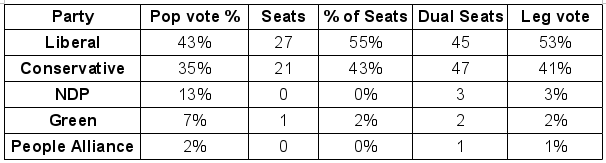
Liberals 53% / Conservatives 41% / NDP 3% / Green 2% / PA 1%

Compare: First past the post  VS  Dual electoral systemsnapshot22As always I suggest forming the Legislative Assembly Advisory Council. The top two candidates in each riding are members with 1 vote in regular session. All the other candidates transfer their popular vote to one of the members from their riding  which when added to their own popular vote becomes the number of votes they have in Legislative session of the Council. The Council in regular session advises the Assembly on procedural motions. The Council in legislative session advises the Assembly on whether to pass a bill into law. The advisory council allows you to try it before you buy it.

If New Brunswick adopted the Dual electoral system the Legislative Assembly should have 25 ridings giving you 50 MLAs. This last election would probably give you 24 Liberals 55% Leg vote / 24 Cons 41% Leg vote / 1 NDP 2% Leg vote / 1 Green 2% Leg vote.

Acting president: Barry Aulis

Revere the Leader

abortion-rights-trump-mps-freedom-to-vote-their-conscienceliberal-caucus-20140819Jus In the natural governing party you revere the Leader. The Liberals have learned nothing and its still the same old same old. But are any of the other parties any better?

12.3 Key resolutions need two third majorities to be passed in the National Assembly, National Congress, and the Federal council. Key resolutions are motioned in the National policy committee. These resolutions form the National Party Platform and are binding upon a Federalist government and all Federalist MPs. Each Federalist MP can vote as they choose in the House of Commons. They may vote against a key resolution without penalty a number of times in each Parliament equal to the number of times they have been elected to the Commons.

I have had this discussion before and what it comes down too is are you a Member of Parliament or are you a Member of Party? The answer is another more basic question the voters and taxpayers of Canada should ask. Who pays their salaries?

With the Federalist party of Canada what comes first is recognition that its the taxpayers who pay an MP’s salary and not the Party and certainly not the Party Leader. But they are also running as the Federalist’s candidate for the House so they are required to support the Party’s platform in Parliament. This support however is not and should not be the absolute that Mr. Trudue is dictating to the members of the Liberal party.

As the Federalist party’s constitution shows Federalist’s MPs can pass on a bloc vote of the caucus a limited number of times in each Parliament. Breaking party ranks beyond this brings the following penalties; first time 90 day suspension from caucus, second time 180 day suspension from caucus and National Congress, third time 1 year suspension of party membership, fourth time its bye bye you are in the wrong party!

Instead of Party discipline rigidity have a system that says you are both MP Member of Parliament and a Member of your Party. I repeat you are a Member of Parliament first why? Because where I come from the One that pays your salary is the one who gets to call the shots!

Barry Aulis

Dear Mr. Prentice

http://wwjim-prenticew.cbc.ca/news/canada/calgary/4-challenges-facing-jim-prentice-1.2758876

Here’s an idea for Premier Prentice. This is a proposed policy resolution.

Introduction
Non-voting members of the House of Commons
Under the standing orders of the House of Commons there shall be created a class of members called House delegates who can motion and debate but have no seat on any committee and no vote in the House of Commons.

Be it resolved
Delegates can be created by an absolute two-thirds majority vote (206) of the Commons. These delegates have a term of office for the duration of that parliament. A House delegate called a Member-emeritus can be created by an absolute three quarters majority vote (231) of the Commons. A Member-emeritus serves for the duration of five parliaments starting with the one in which they are created. All Speakers of the House become a Member-emeritus for life in the Parliament after they retire.

Be it further resolved
There shall be ex-official House delegates who are any member of the Council of Ministers or the Council of Opposition who does not have a seat in the House of Commons. Furthermore both the Prime Minister and the Leader of the Opposition shall only be House delegates. If they are members of the House of Commons at the time of appointment as Prime minister or Leader of the opposition they then shall resign that seat in the House of Commons. Also if any leader of an official political party does not have a seat in the House of Commons they shall become a delegate member of the Commons. The status of an official political party shall be granted to any party, which got 5% or more of the popular vote
in the last election or who has 1% or more of the membership in the House of Commons.

By appointment as Premier of Alberta Mr. Prentice also becomes an Assembly delegate in the Alberta legislature. As for his idea for terms limits from the Federalist party’s constitution and Bylaws.

11.0 The Party shall hold a leadership election no earlier then 3 years after the last vote and no later then 6 years after the last leadership election. The winner is elected Leader of the Party and the runner-up as the Deputy leader.

11.1 It is a vote in the National Congress in regular session that sets the month for the leadership vote. The Leader may serve at most 3 terms as Leader of the Party.

That members of the Federalist party be barred from running for the party’s nomination for the House of Commons if they have served as an MP in 6 Parliaments or have been the Federalist’s candidate 8 times.