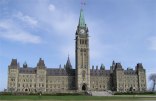
A reformed legislative process.
Legislative motions are either Bills or Resolutions.
Bills if passed by Parliament become Acts of Parliament and have the force of Law.
Resolutions are non-binding legislative motions that if passed by Parliament do not have the force of Law being only an official statement of Parliament.
Only the Council of Ministers (the Government) or Council of Opposition (the Opposition) can introduce Bills.
Resolutions can be introduced by 1% of the House membership or 4 members.
All legislative motions are introduced into the House of Commons.
On Monday all legislative motions are introduced into the House of Commons.
After any legislative motions are introduced notices of motion of closure are given for any legislative motions including the ones just introduced. This notice is given by the sponsor of that legislative motion.
On Tuesday without debate any motions of closure is voted upon. If passed any committee consideration of the legislative motion is stopped and all debate on the House floor for the legislative motion is ended. The legislative motion then goes up for a vote to pass the House of Commons in Legislative session which is every Wednesday afternoon at 1 PM.
To pass a motion of closure requires the following votes as a percentage of the full House.
Just introduced 100% 308 votes (Conservatives+NDP+Liberals+Others)
1 week after introduction 90% 278 votes (Conservatives+NDP+Liberals)
4 weeks after 75% 231 votes (Conservatives+NDP)
13 weeks 67% 206 votes (Conservatives+NDP or +Liberals+Others)
26 weeks 60% 185 votes (Conservatives+NDP or +Liberals)
39 weeks 50% 154 votes (Conservatives)
52 weeks 33% 103 votes (Conservatives or NDP+Liberals or NDP+Others)
On Wednesday the House of Commons goes into legislative session at 1 PM and votes to pass any legislative motions. The government and opposition each get 10 minutes to make a last speech on the Bill/resolution before the vote. If passed it goes to the Senate.
On Thursday the Senate of Canada goes into legislative session at 1 PM and votes on any legislative motions passed by the Commons on Wednesday. If nothing passed the House the Senate will be in regular session.
Any legislative motions that passed the Senate on Thursday are given royal assent on Friday by the Governor-General.
However you set the necessary votes for a motion of closure the two principles remain. The majority can not be blocked from passing something it has the votes for and the minority can not be ignored or overruled by a simple majority vote.
The power of Democracy is vested in the majority and in the minority it’s principle.

 The Federalist party of Canada